
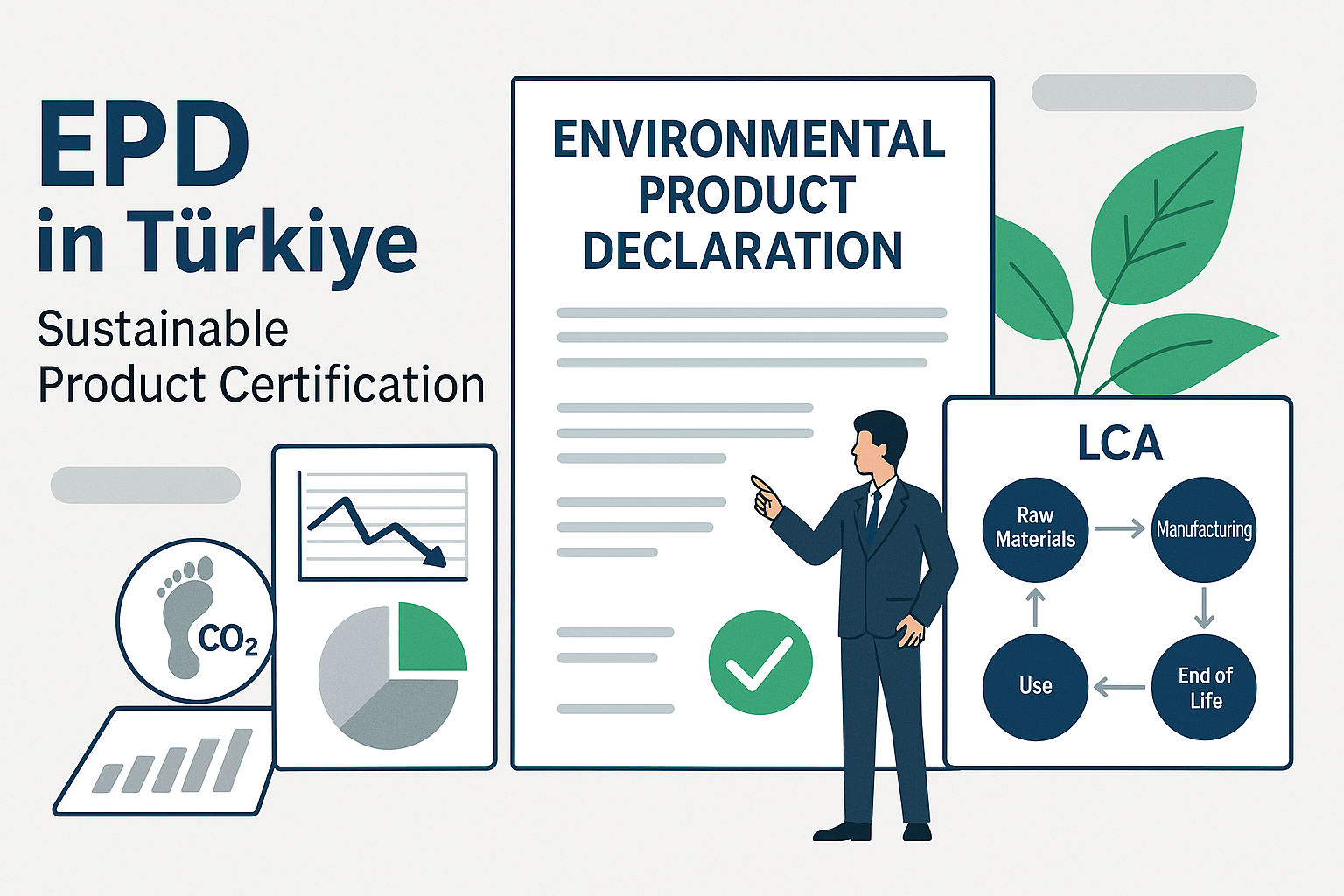
EPD in Türkiye is becoming one of the most critical tools for manufacturers aiming to improve sustainability performance and stay competitive in global markets. As transparency and life-cycle-based reporting grow worldwide, Turkish industries increasingly rely on Environmental Product Declarations to demonstrate measurable environmental data.
This blog explores why EPDs matter, how they accelerate sustainability transformation in Türkiye, and what strategic steps companies should take to adopt them efficiently.
1. What Exactly Is an EPD and Why Is It Crucial for Türkiye?
An Environmental Product Declaration (EPD) is a verified and standardized document that communicates the environmental performance of a product based on a Life Cycle Assessment (LCA). The methodology is governed by ISO 14025 and EN 15804, ensuring accuracy, comparability, and international acceptance.
Türkiye’s industrial landscape—especially construction, building materials, plastics, textiles, and metals—has begun to feel the pressure of global green procurement requirements. Many international buyers now require EPDs as a prerequisite for tenders, green building certifications, and export compliance.
EPDs help Türkiye’s manufacturers:
-
Demonstrate environmental responsibility with measurable data
-
Increase competitiveness in EU and global trade
-
Support market access for products facing strict sustainability standards
-
Build trust with stakeholders and environmentally conscious clients
-
Position themselves as leaders in low-carbon innovation
For a detailed understanding of international EPD rules and frameworks, you may refer to the International EPD System (https://www.environdec.com/).
2. How EPD Certification Aligns with Global Sustainability Goals
EPDs align with multiple sustainability frameworks that modern industries must comply with:
Alignment with Carbon Footprint & Climate Policies
As the EU’s Carbon Border Adjustment Mechanism (CBAM) expands, Turkish exporters will increasingly rely on EPD data to validate carbon footprint calculations. Since EPDs quantify CO₂ emissions across all life cycle stages, they offer a transparent and credible baseline for emissions reporting.
Integration with Green Building Standards
EPDs play a major role in sustainability rating systems such as:
-
LEED v4.1
-
BREEAM
-
DGNB
-
WELL Building Standard
In Türkiye, green building projects are growing rapidly, especially in metropolitan regions such as İstanbul, Ankara, İzmir, Bursa, and Antalya. EPD-labelled construction materials support higher certification scores and are often preferred during procurement.
3. The Rise of EPD Adoption in Türkiye’s Manufacturing Sectors
Türkiye’s commitment to environmental transparency has risen significantly in the last five years. Many local manufacturers—cement, steel, aluminum, ceramics, insulation, chemicals, and plastics—are actively seeking EPD documentation to compete in European markets.
Key Drivers Behind This Increase
-
Strong export orientation
-
EU Green Deal pressure
-
Public sector sustainability goals
-
Corporate ESG reporting
-
Investor and stakeholder expectations
Additionally, several Turkish producers are now publishing EPDs as part of their corporate sustainability strategies. The growing number of sector-wide Product Category Rules (PCRs) has made the process more accessible.
A comprehensive list of approved PCRs worldwide can be found in the Ecoinvent PCR Library (https://ecoinvent.org).
4. Understanding the EPD Process: From LCA to Verification
Obtaining an EPD in Türkiye follows a globally standardized workflow:
Step 1 — Defining Product Category Rules (PCRs)
PCRs provide the methodological framework for conducting LCAs. Choosing the right PCR ensures your product aligns with international comparability requirements.
Step 2 — Life Cycle Assessment (LCA)
LCA evaluates environmental impact across all stages:
-
Raw material extraction
-
Manufacturing
-
Transportation
-
Use phase (if applicable)
-
End-of-life
This is the most critical phase, requiring accurate data collection and modeling.
Step 3 — EPD Documentation
After completing LCA, results are compiled into an EPD document following ISO/EN standards.
Step 4 — Third-Party Verification
Independent accredited verifiers ensure the EPD meets all technical requirements.
Step 5 — Publication
The final EPD is published in a recognized program (e.g., International EPD System), making it globally accessible.
To explore how ERKE supports this process, you may visit our Life Cycle Assessment Services page:
➡️ https://erkeconsultancy.com/life-cycle-assessment-services/
5. Why EPDs Are Critical for Türkiye’s Export Competitiveness
For exporters, EPDs are no longer optional—they are becoming essential for sustaining market access. Industries exporting to the UK, EU, Japan, and GCC countries face strict sustainability criteria within procurement and certification systems.
EPDs Provide Competitive Advantages Such As:
-
Increased visibility in global markets
-
Easier entry into sustainable supply chains
-
Better scoring in international tenders
-
Improved brand reputation
-
Verified, science-based sustainability claims
With Türkiye expected to intensify its role in the European green supply chain, EPD adoption will continue rising sharply.
6. Strengthening Türkiye’s Sustainable Economy Through EPD Integration
EPDs support Türkiye’s transition to a low-carbon and transparent economic model. They encourage:
-
Cleaner production techniques
-
Efficient resource use
-
Greater product innovation
-
Environmental accountability
-
Reduced regulatory risk
Industries adopting EPDs early will benefit from a stronger global presence and long-term resilience.
7. How ERKE Consultancy Supports EPD Development in Türkiye
ERKE Sustainability Consultancy provides comprehensive end-to-end support for companies seeking EPD certification. Our services include:
-
Sustainability roadmap creation
-
Data collection and environmental modeling
-
LCA calculations based on ISO 14040/44
-
EPD documentation preparation
-
Third-party verifier coordination
-
Program operator submission and publication
-
Annual sustainability reporting and continuous improvement
As Türkiye increasingly integrates with global sustainability markets, ERKE stands as one of the country’s leading partners for EPD, LCA, ESG, and green building consultancy.
Conclusion: Türkiye’s Future Depends on Transparent, Verified Environmental Data
Environmental Product Declarations serve as a strategic bridge between sustainability ambitions and internationally recognized performance metrics. Türkiye’s manufacturers, exporters, and material suppliers who adopt EPDs today will strengthen their market resilience tomorrow.
For expert support in preparing an EPD tailored to global standards, ERKE Sustainability Consultancy is ready to guide organizations at every step.
https://erketasarim.com/epd-belgesi