
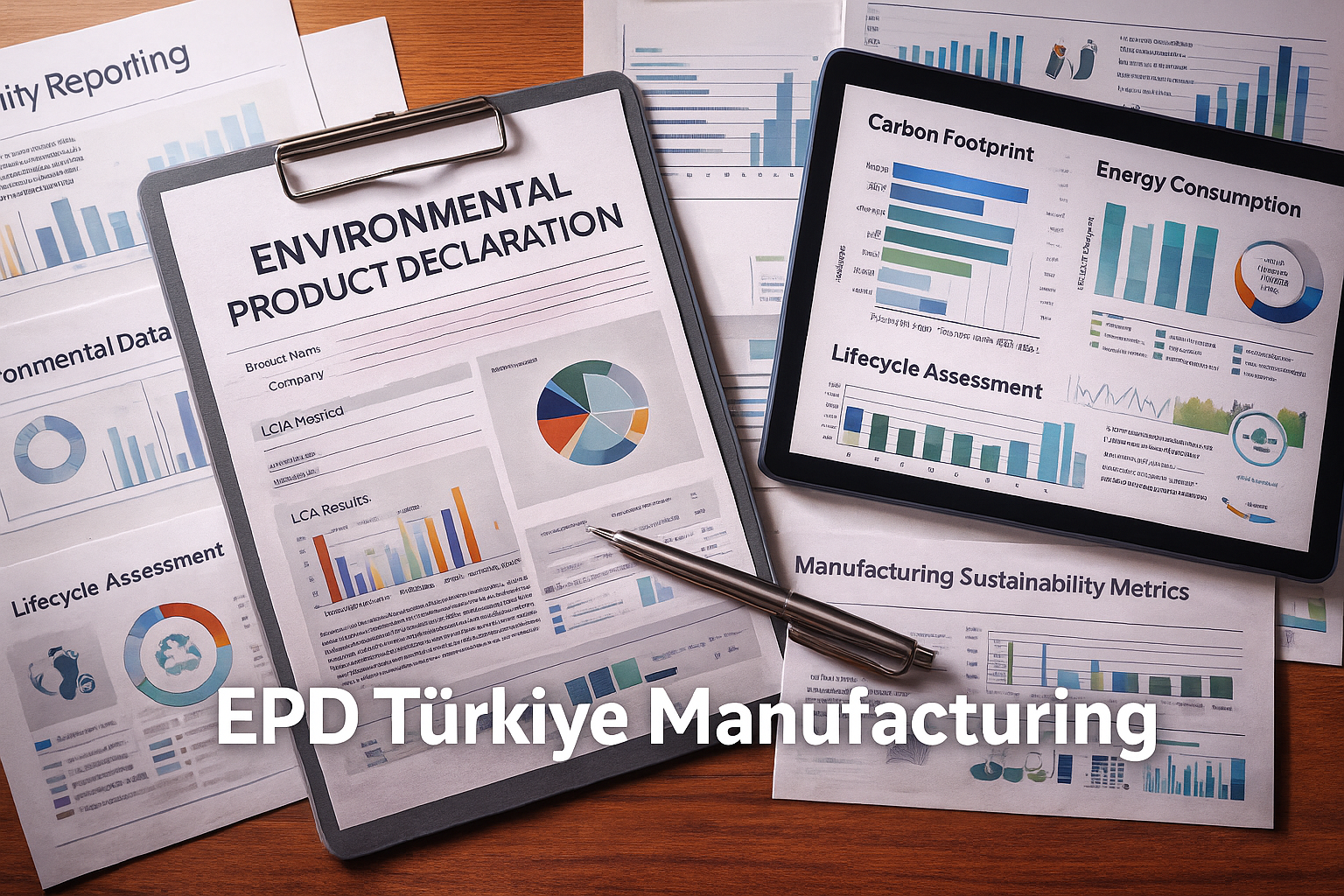
EPD Türkiye manufacturing practices are rapidly evolving as companies seek stronger environmental transparency and data-driven sustainability strategies. In Türkiye’s manufacturing sector, Environmental Product Declarations (EPDs) now play a central role not only in documentation but also in improving decision-making and competitiveness.
This article explores how EPDs support more informed decision-making, enable competitive differentiation, and strengthen sustainability strategies across Turkish industries—offering a deeper perspective that goes beyond simply obtaining a certificate.
1. EPDs as Strategic Instruments for Environmental Data Management
Traditionally, many companies viewed EPDs as an external requirement—necessary for tenders, exports, or compliance with green building standards. However, as Türkiye’s manufacturing landscape becomes more data-driven, organizations are beginning to treat EPDs as powerful internal tools for understanding product performance.
EPDs provide sector-specific, quantifiable insights, including:
-
Global warming potential (GWP)
-
Energy demand and resource use
-
Water consumption
-
Waste generation
-
Transportation and logistics impacts
-
End-of-life scenarios
These metrics allow manufacturers to evaluate environmental hotspots, identify improvement areas, and prioritize actions that reduce costs and environmental burdens simultaneously.
For international methodology and standardization details, you may refer to the ISO 14025 Guidelines:
https://committee.iso.org/home.html
2. Supporting Turkish Manufacturers in Global Low-Carbon Supply Chains
As Türkiye integrates more deeply with European and global supply networks, environmental data has become a prerequisite for supplier selection. Companies within construction, metals, textiles, plastics, chemicals, and packaging are expected to present transparent, verifiable impact data.
EPDs help Turkish manufacturers achieve:
Supply Chain Eligibility
Large corporations are increasingly screening suppliers using carbon and resource-use criteria. EPDs demonstrate readiness and compliance.
Cross-Border Trading Advantages
European buyers favor products with standardized environmental declarations aligned with EN 15804. This gives Turkish producers a measurable competitive advantage.
Reliable Climate Reporting
With climate policies tightening, companies need accurate baseline data for Scope 3 reporting. EPDs provide that foundation.
For reference, the European Commission’s Sustainable Products Initiative outlines future expectations:
https://commission.europa.eu/energy-climate-change-environment/standards-tools-and-labels/products-labelling-rules-and-requirements_en
3. How EPD Insights Improve Product Design and Innovation
One of the most overlooked benefits of EPDs is their impact on innovation. By analyzing the full life cycle of a product, companies can identify areas where redesign, material substitution, or process optimization leads to noticeable improvements.
Examples of improvements driven by EPD data:
-
Switching to lower-carbon raw materials
-
Redesigning packaging to reduce weight
-
Improving energy efficiency during production
-
Optimizing logistics routes and load efficiency
-
Reusing process heat or waste materials
-
Designing products with end-of-life reuse pathways
In Türkiye, where industry is rapidly modernizing, EPD-driven optimization can help organizations remain competitive while supporting national sustainability ambitions.
4. EPDs and Türkiye’s Transition to a More Transparent Manufacturing Economy
Türkiye’s manufacturing ecosystem is moving toward greater transparency, encouraged by:
-
Export conditions
-
Investor and stakeholder expectations
-
National climate commitments
-
Voluntary corporate sustainability goals
EPDs play a critical role in this transformation by enabling standardized, comparable, and verifiable data exchange across the value chain.
Key benefits at the national scale:
-
Strengthening international market trust
-
Building a more resilient and modern industrial base
-
Supporting carbon reduction strategies
-
Encouraging resource-efficient production
-
Enabling fair competition through transparent metrics
As Türkiye aims for stronger integration with global sustainability frameworks, the role of EPD data becomes increasingly important.
5. Why Data Quality Matters More Than Ever
High-quality, accurate data ensures an EPD truly reflects product performance. Poor or incomplete data weakens competitiveness and can lead to inconsistencies during verification.
High-quality EPDs require:
-
Reliable primary data from production
-
Accurate energy and material flow measurements
-
Robust LCA modelling following ISO 14040/44
-
Alignment with the correct Product Category Rules (PCR)
-
Transparent assumptions and system boundaries
Companies that manage these elements effectively are better positioned to meet evolving market demands.
To understand how high-quality LCA data supports EPD generation, you can explore ERKE’s internal services page:
➡️https://erkeconsultancy.com/lca-consulting/
6. The Growing Importance of EPDs in Türkiye’s Construction and Infrastructure Projects
Construction is one of Türkiye’s most internationally connected industries. Large-scale projects—such as airports, mixed-use developments, public buildings, and industrial facilities—are increasingly incorporating sustainability criteria that rely on EPD documentation.
How EPDs support the construction sector:
-
Facilitating procurement decisions
-
Improving LEED, BREEAM, DGNB, and WELL scores
-
Reducing embodied carbon in materials
-
Enhancing transparency across subcontracted supply chains
-
Providing third-party verified environmental data
Given Türkiye’s strong position in global construction, manufacturers offering EPD-backed materials become preferred partners.
7. Long-Term Value: Beyond Certification and Compliance
EPDs are not merely checkboxes—they contribute to long-term value creation. Companies that integrate EPD data into their sustainability strategies gain:
-
Better risk management
-
Stronger environmental governance
-
Increased stakeholder confidence
-
Reliable metrics for reporting and benchmarking
-
A future-proofed position as regulations evolve
For Turkish manufacturers adapting to international environmental expectations, the strategic value of EPDs continues to grow each year.
Conclusion: Using EPDs to Strengthen Türkiye’s Manufacturing Future
EPDs provide companies with more than environmental declarations—they offer actionable insights that support product optimization, market competitiveness, and effective sustainability management. As Türkiye continues its transition toward a more transparent, responsible, and internationally integrated industrial ecosystem, the ability to produce and leverage high-quality EPD data will be essential.
ERKE Sustainability Consultancy supports organizations throughout this process with comprehensive expertise in LCA modelling, environmental data management, and EPD documentation—helping companies make informed decisions that contribute to a stronger, sustainable future for Türkiye’s manufacturing sector.