
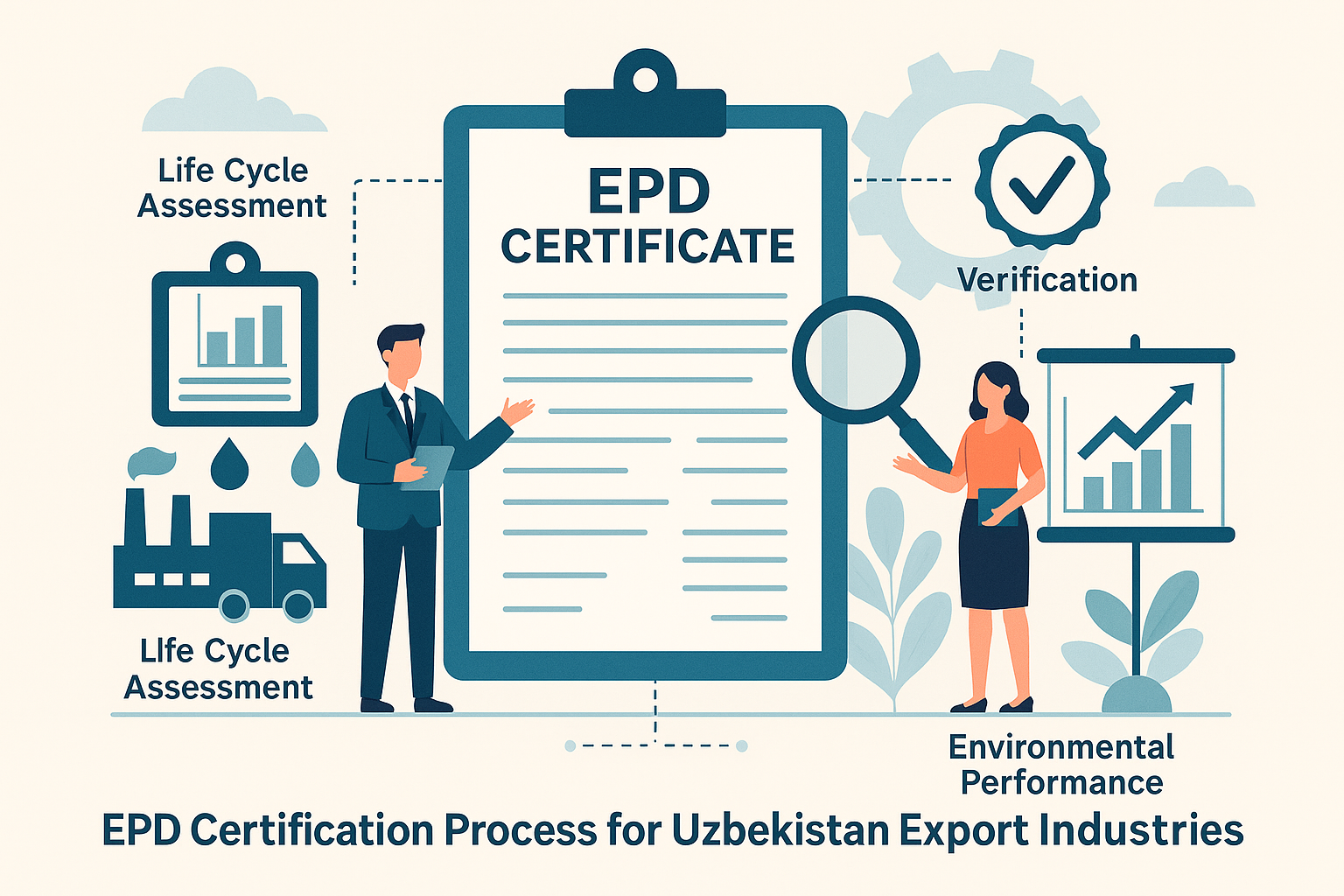
As Uzbekistan accelerates its industrial development and strengthens its export capacity, global market expectations around environmental transparency have become increasingly important. Manufacturers in sectors such as construction materials, textiles, plastics, chemicals, and metal products are rapidly discovering that the Environmental Product Declaration (EPD) certificate is essential for accessing European, UK, Japanese, and Middle Eastern markets.
As ERKE Sustainability Consultancy, we provide internationally recognized EPD services—including Life Cycle Assessment (LCA), documentation, verification, and publication—supporting Uzbek companies in achieving full compliance with global standards.
What Is an Environmental Product Declaration (EPD) Certificate?
An Environmental Product Declaration (EPD) is a standardized and verified document that presents quantifiable environmental data of a product’s lifecycle. It is developed in accordance with ISO 14025, ISO 14040/44, and EN 15804 standards.
An EPD certificate transparently reports:
-
Raw material extraction impacts
-
Energy and water consumption
-
Transportation and distribution impacts
-
Production processes
-
Use-phase impacts
-
End-of-life treatment
-
Waste generation
-
Overall environmental performance
EPDs are product-specific, data-driven, and third-party verified, making them one of the most trusted sustainability documents in the global marketplace.
To learn more about how EPDs are interpreted in green building systems, you may refer to the official ECO Platform database:
👉 https://www.eco-platform.org/eco-epd-40.html
Why EPD Certification Matters for Uzbekistan
Uzbekistan is becoming a competitive manufacturing and export hub in Central Asia. However, entering international markets—especially Europe, UK, and Japan—requires compliance with strict environmental transparency criteria. EPD certificates provide Uzbek manufacturers with the required credibility, documentation quality, and competitive edge.
1. Increasing Global Demand for Sustainable Products
International buyers and construction companies prefer products with certified environmental performance. EPDs provide:
-
Assurance of third-party verified data
-
Compliance with international procurement standards
-
Compatibility with green building certifications
Green building programs like LEED and BREEAM award points for using products with EPDs.
Learn more about LEED-related opportunities here:
👉 https://erkeconsultancy.com/leed-consulting
2. Access to High-Value Export Markets
Countries such as Germany, Sweden, the UK, and Japan often require EPDs from suppliers entering construction, manufacturing, and public procurement sectors. Without an EPD, many Uzbek manufacturers may be excluded from major tenders.
Useful resource:
Official EN 15804 information from CEN (European Committee for Standardization):
👉 https://www.cencenelec.eu
3. Competitive Advantage Against Global Producers
Many industries in Turkey, Europe, and East Asia already widely use EPD certification. Uzbek manufacturers seeking to differentiate themselves can strategically use EPDs to demonstrate their environmental responsibility.
4. Support for Domestic Sustainability Targets
EPDs help companies understand their environmental impacts and identify reduction opportunities. As Uzbekistan moves toward greener industry standards, EPDs will support national sustainability goals aligned with global practices.
How the EPD Certification Process Works
The EPD process is systematic, transparent, and supported by internationally recognized methodologies. ERKE manages the full lifecycle of EPD development for Uzbek manufacturers.
1. Identification of Product Category Rules (PCRs)
Each type of product has a specific PCR that defines how the environmental impacts must be calculated.
A PCR ensures consistency across similar products, enabling accurate comparison.
PCR library reference:
👉 https://www.environdec.com/pcr-library
2. Data Collection
We work closely with the manufacturer to gather operational data such as:
-
Raw material input quantities
-
Energy usage
-
Water consumption
-
Packaging
-
Transportation distances
-
Manufacturing waste
-
End-of-life scenarios
3. Life Cycle Assessment (LCA) Modelling
Using ISO 14040/44 methodology, ERKE performs the full LCA analysis. This includes:
-
Goal and scope definition
-
System boundary selection
-
Impact assessment (GWP, ODP, AP, EP, etc.)
-
Interpretation and verification of results
4. Drafting the EPD Document
ERKE prepares the complete EPD documents in English, including:
-
Product description
-
Functional unit
-
System boundaries
-
Life cycle inventory
-
Environmental impact tables
-
Resource use
-
Verification statements
5. Third-Party Verification
EPD documents must be reviewed and approved by accredited independent verifiers. ERKE coordinates the entire verification process through globally recognized program operators.
6. Publication and Global Visibility
Once approved, the EPD is published in international databases such as:
-
International EPD System
-
ECO Platform
-
EPD Norge
-
UL Environment
This gives Uzbek manufacturers formal global recognition.
Industries in Uzbekistan That Benefit Most from EPD Certification
1. Construction Materials
Products such as:
-
Cement
-
Concrete
-
Ceramic tiles
-
Insulation materials
-
Aluminum and steel components
-
Flooring and wall systems
are increasingly required to have EPDs in Europe and the Middle East.
2. Textile and Cotton-Based Products
Uzbekistan’s textile exports can strongly benefit from environmental transparency, especially when selling to European brands.
3. Plastics, Polymers, and Packaging
Manufacturers producing:
-
Plastic piping
-
Polymer components
-
Industrial packaging
can leverage EPDs to enter international markets more competitively.
4. Chemicals and Industrial Materials
Chemical intermediates, coatings, additives, and adhesives used in the construction sector also require environmental documentation.
5. Metal and Machinery Components
Steel parts, fasteners, mechanical equipment, and fabricated metal products gain higher visibility with EPDs.
Key Benefits of an Environmental Product Declaration (EPD) Certificate
1. Transparency and Credibility
EPDs provide scientifically backed environmental information, improving buyer confidence and brand reputation.
2. Preferential Selection in International Projects
Developers, designers, and green building consultants actively seek EPD-certified products.
3. Compliance With Procurement Requirements
Government and commercial tenders in Europe and the Middle East increasingly demand EPD documentation.
4. Contribution to Sustainability Certifications
EPDs support credit achievement in:
-
LEED (Material & Resources category)
-
BREEAM (Mat 01 Life Cycle Impacts)
-
DGNB (LCA & product transparency categories)
5. Strategic Environmental Planning
The insights gained from LCA allow companies to improve:
-
Material efficiency
-
Energy usage
-
Supply chain optimization
-
Carbon reduction strategies
Common Challenges for Uzbek Manufacturers and How ERKE Solves Them
Challenge 1: Collecting Accurate Data
Many companies struggle with gathering detailed environmental data.
ERKE Solution: Structured data templates and on-site data support.
Challenge 2: Understanding ISO Requirements
ISO 14025 / 14040/44 and EN 15804 can be difficult to interpret.
ERKE Solution: Full compliance management and technical coordination.
Challenge 3: Choosing the Correct Program Operator
Different markets value different EPD databases.
ERKE Solution: We select the program operator aligned with the company’s export targets.
Challenge 4: Verification and Publication
Companies often do not know how to navigate verification procedures.
ERKE Solution: ERKE handles all verifier interactions on behalf of the client.
Why ERKE Sustainability Consultancy Is the Right Partner for Uzbekistan
ERKE has broad international experience with EPD, LCA, green building certifications, and sustainability reporting. With established operations in Türkiye, Japan, Sweden, the UK, and Europe, our methodologies are aligned with global best practices.
We support Uzbek manufacturers with:
-
End-to-end EPD creation
-
LCA modelling
-
Program operator selection
-
Third-party verification
-
Publication and renewal
-
Export-focused sustainability strategies
For sustainability-related services beyond EPD, visit our general sustainability portfolio:
👉 https://erkeconsultancy.com/sustainable-material-analysis/
Conclusion
The Environmental Product Declaration (EPD) certificate is more than just a technical document; it is a strategic asset that enables Uzbek manufacturers to compete globally, win international tenders, and build trusted, transparent brands.
As Uzbekistan expands its industrial capacity, EPD certification will become a crucial requirement—not only for exports but also for long-term sustainability performance.
ERKE Sustainability Consultancy is ready to support Uzbekistan’s industry with world-class EPD services from start to finish.
https://epdturkiye.com/iletisim/