As Uzbekistan continues its rapid economic growth and urban transformation, sustainability has become a strategic priority—especially within construction and real estate. One of the most effective ways global investors and local developers ensure environmental responsibility is through green building certifications. Understanding what are green building certifications is essential for organizations striving to enhance building performance, reduce carbon emissions, and align with global ESG expectations. At ERKE Sustainability Consultancy, we support projects across Central Asia in adopting international sustainability frameworks and obtaining globally recognized certifications.
Why Green Building Certifications Matter for Uzbekistan’s Future
Uzbekistan is uniquely positioned to benefit from green building standards. With increasing industrial activity, new construction investments, and global supply-chain integration, certified buildings offer advantages such as lower operational costs, healthier indoor environments, and stronger international investor confidence. Certifications also enhance compliance with global sustainability reporting mechanisms, including the UN Sustainable Development Goals.
To support these goals, ERKE Sustainability Consultancy assists regional developers through expert guidance, certification management, environmental assessments, and long-term sustainability planning. You can explore our full service range here:
-
ERKE Sustainability Consultancy – Services → https://erkeconsultancy.com/green-building-consultancy/
-
LEED Consulting Support → https://erkeconsultancy.com/leed-consulting
-
Sustainability Strategy & Advisory → https://erkeconsultancy.com/what-we-do/
Understanding Green Building Certifications (GBCs): Global Frameworks for Sustainable Construction
Green building certifications are internationally recognized systems that evaluate a building’s environmental, social, and economic performance. They help ensure that projects use fewer resources, produce less waste, and create healthier spaces for occupants. These certifications typically assess areas such as:
-
Energy efficiency and renewable energy use
-
Water conservation
-
Material sustainability and environmental product declarations (EPDs)
-
Indoor environmental quality
-
Green site selection and ecological protection
-
Waste reduction and circular economy alignment
By asking what are green building certifications, we uncover a worldwide ecosystem of rating systems that guide sustainable construction across regions and climates.
Popular Green Building Certifications Used Worldwide
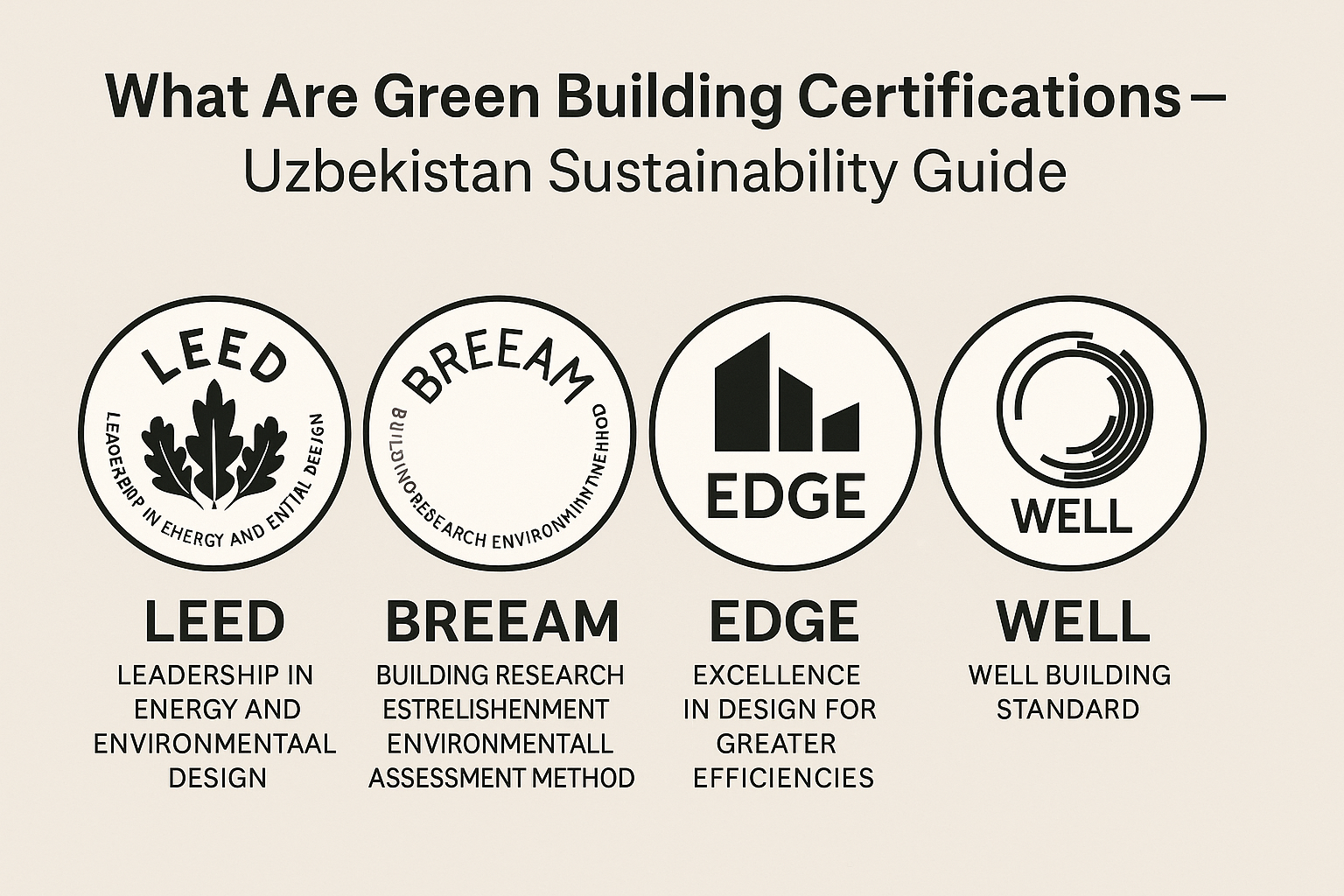
1. LEED Certification (Leadership in Energy and Environmental Design)
LEED, developed by the U.S. Green Building Council, is one of the most widely adopted sustainability rating systems globally. With categories such as Building Design & Construction (BD+C), Interior Design & Construction (ID+C), and Operations & Maintenance (O+M), LEED is increasingly used for new projects in Uzbekistan.
External reference:
-
USGBC – LEED Overview → https://www.usgbc.org/leed
Leading organizations in Central Asia often choose LEED to demonstrate international competitiveness and meet ESG requirements.
2. BREEAM (Building Research Establishment Environmental Assessment Method)
Originating from the UK, BREEAM is another globally recognized certification. It focuses on the environmental performance of buildings from design through operation.
External reference:
-
BREEAM Official Site → https://www.breeam.com
BREEAM is known for its flexibility and detailed assessment lifecycle, making it suitable for large-scale commercial or industrial buildings.
3. EDGE (Excellence in Design for Greater Efficiencies)
EDGE, powered by the International Finance Corporation (IFC), is especially popular in emerging markets. It targets measurable energy, water, and material savings — a perfect match for Uzbekistan’s climate and development needs.
External reference:
-
IFC EDGE → https://www.edgebuildings.com
Because EDGE is cost-effective and accessible, it has become a preferred choice for residential, hospitality, and mid-scale commercial developments.
4. WELL Building Standard
While not a traditional environmental certification, WELL focuses on human health and wellness. It evaluates building performance based on air quality, light, comfort, nourishment, and community wellbeing.
External reference:
-
WELL Building Standard → https://www.wellcertified.com
In Uzbekistan’s fast-growing corporate and commercial sectors, WELL can significantly enhance workplace health and productivity.
How Green Building Certifications Support Uzbekistan’s Sustainability Goals
Carbon Reduction & Energy Savings
Green certified buildings consume less energy and incorporate smarter technologies such as solar photovoltaics, passive cooling, and building automation systems. For a country with growing energy demand, these efficiency measures offer long-term savings.
Healthier Indoor Environments
Air quality remains a top concern in many urban areas. Certifications like WELL and LEED prioritize ventilation rates, filtration, and material toxicity controls—helping developers create safer, healthier spaces.
International Investor Confidence
Many foreign investors require green certification compliance as part of their ESG reporting. Projects in Uzbekistan that obtain LEED or EDGE gain stronger access to global financing and partner networks.
Regulatory Alignment & Global Trade Integration
As Uzbekistan deepens trade relations with the EU and global markets, green building certifications support alignment with environmental directives, carbon border adjustments (CBAM), and supply-chain sustainability reporting.
Steps to Achieve a Green Building Certification in Uzbekistan
1. Pre-Assessment & Strategy Development
ERKE consultants begin with a feasibility study to determine certification options, cost-benefit analyses, and energy-efficiency opportunities.
2. Documentation & Technical Submission
Certification systems require detailed environmental and design documentation. ERKE manages the complete submission process, ensuring full compliance with international standards.
3. On-Site Verification & Performance Measurement
Building performance must be validated through audits, energy modeling, LCA studies, and environmental measurements. Certifications such as LEED require precise evidence.
4. Final Certification & Continuous Monitoring
Once awarded, certified buildings benefit from long-term monitoring, recertification planning, and performance tracking to maintain sustainable operations.
Green Building Certifications & Environmental Product Declarations (EPDs)
Green certifications frequently require transparency in material sustainability. EPDs—ISO-based environmental product declarations—support this need by providing environmental performance data for construction materials.
For more information, ERKE offers EPD consulting across Europe and Central Asia.
External reference supporting EPD standards:
-
International EPD System → https://www.environdec.com
Why Partner with ERKE Sustainability Consultancy in Uzbekistan?
ERKE has been a leading sustainability consultant across Europe, the Middle East, and Central Asia. With extensive experience in LEED, BREEAM, WELL, EDGE, and EPD services, we support companies in Uzbekistan with:
-
Full-cycle certification management
-
Energy and carbon modeling
-
Sustainable materials and EPD guidance
-
ESG reporting alignment
-
Green financing support
Our regional expertise ensures seamless collaboration, technical accuracy, and globally recognized results.
Conclusion: Building a Sustainable Future for Uzbekistan
Understanding what are green building certifications is the first step toward aligning new developments in Uzbekistan with global sustainability goals. Certifications not only reduce environmental impact but also strengthen corporate reputation, increase operational efficiency, and unlock international investment opportunities.
As Uzbekistan continues to modernize its built environment, adopting LEED, BREEAM, EDGE, or WELL can help organizations build smarter, greener, and more future-ready projects.
To begin your certification journey, connect with ERKE Sustainability Consultancy and explore our tailored services for the region.