Building Life Cycle Analysis (LCA) has become a critical decision-making tool for developers, investors, and policymakers aiming to reduce carbon emissions in the built environment. In Saudi Arabia—where Vision 2030 places sustainability, decarbonization, and green construction at the center of national development—understanding a building’s carbon footprint from cradle to grave is no longer optional; it is strategic.
As construction activity continues to grow across megaprojects, mixed-use developments, and infrastructure investments, Building Life Cycle Analysis (LCA) provides a scientific and transparent framework to quantify environmental impacts throughout the entire lifespan of a building. This article explores how LCA works, why it matters in the Saudi context, and how organizations can leverage it to achieve regulatory compliance, operational efficiency, and long-term environmental value.
What Is Building Life Cycle Analysis (LCA)?
Building Life Cycle Analysis (LCA) is a standardized methodology used to assess the environmental impacts associated with all stages of a building’s life. Unlike traditional assessments that focus only on operational energy, LCA evaluates embodied carbon and operational carbon together, offering a complete emissions profile.
LCA studies are typically conducted in accordance with international standards such as ISO 14040 and ISO 14044, ensuring comparability and scientific rigor. The results are expressed in measurable indicators, most notably Global Warming Potential (GWP), which reflects carbon dioxide equivalent (CO₂e) emissions.
Cradle to Grave: The Full Carbon Footprint of a Building
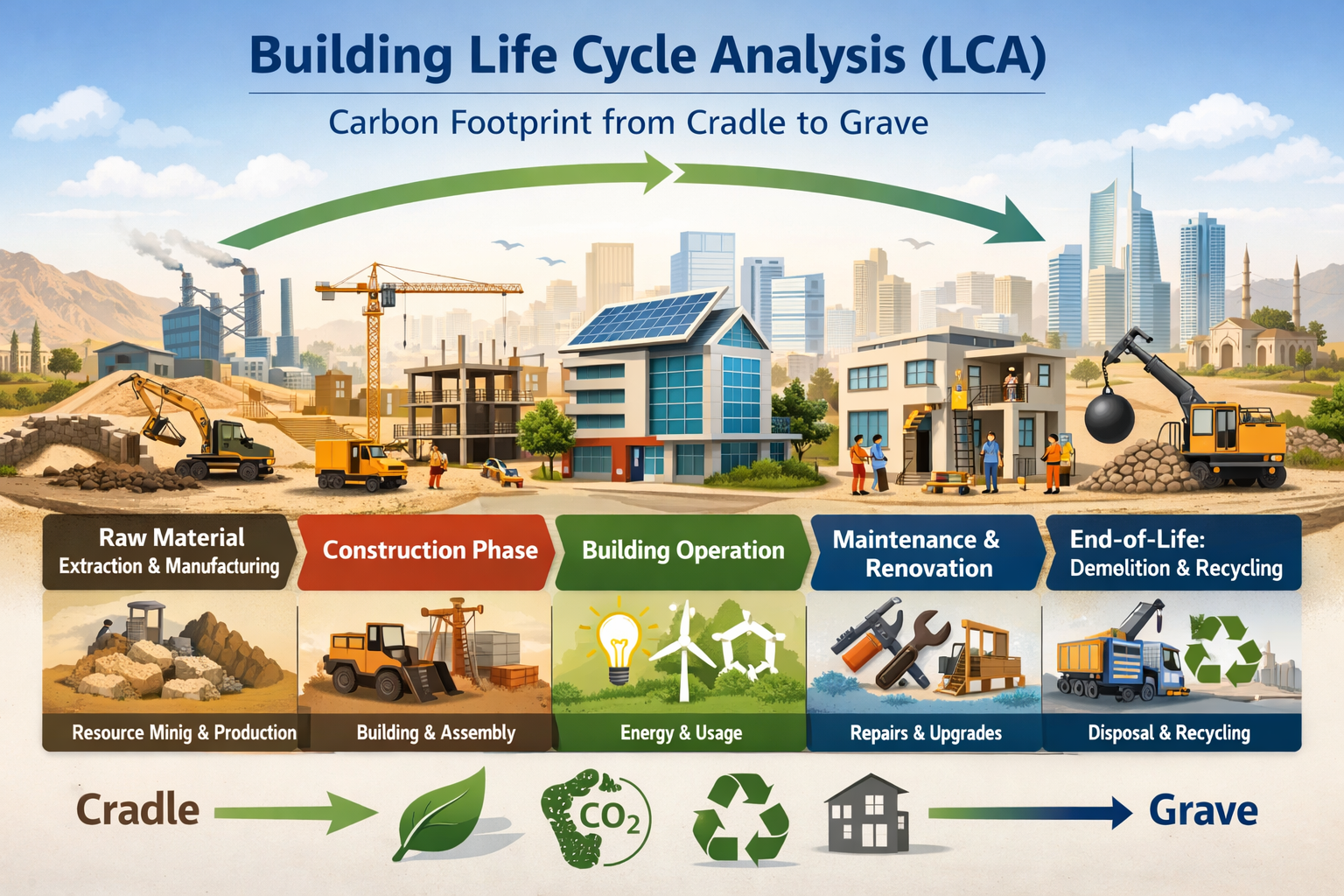
1. Raw Material Extraction and Manufacturing (Cradle)
The first stage of Building Life Cycle Analysis (LCA) begins with the extraction of raw materials such as limestone, steel ore, sand, and aggregates. These materials are processed into cement, steel, aluminum, glass, and insulation—often the most carbon-intensive phase of the building life cycle.
In Saudi Arabia, where construction materials are produced both locally and imported, LCA helps quantify:
-
Energy consumption during manufacturing
-
Emissions from transportation and logistics
-
Differences between conventional and low-carbon material alternatives
Using Environmental Product Declarations (EPDs) is essential at this stage. Verified product data improves the accuracy of LCA results and supports informed procurement decisions.
2. Construction Phase Impacts
The construction phase includes on-site activities such as machinery use, temporary energy consumption, waste generation, and material losses. While this stage is shorter in duration, its carbon footprint is significant, particularly for large-scale developments.
Building Life Cycle Analysis (LCA) allows project teams to:
-
Compare construction methods and sequencing
-
Optimize material efficiency
-
Reduce waste and site-related emissions
For Saudi megaprojects, where scale amplifies impact, early-stage LCA modeling can lead to measurable carbon reductions before construction even begins.
3. Operational Carbon During Building Use
Operational energy has traditionally been the primary focus of sustainability strategies. In hot climates like Saudi Arabia, cooling loads, lighting, and water desalination-related energy consumption dominate operational emissions.
Through Building Life Cycle Analysis (LCA), operational carbon is evaluated over decades, considering:
-
Energy performance and HVAC efficiency
-
Renewable energy integration
-
Maintenance and replacement cycles
When combined with energy modeling, LCA provides a robust basis for aligning building performance with national energy efficiency goals and green building certifications.
4. Maintenance, Refurbishment, and Replacement
Over its lifespan, a building undergoes maintenance activities and component replacements—façades, finishes, mechanical systems, and interiors. These recurring impacts are often overlooked but can account for a substantial share of total emissions.
A comprehensive Building Life Cycle Analysis (LCA) includes:
-
Replacement frequency assumptions
-
Material durability comparisons
-
Long-term carbon implications of design choices
This stage is particularly relevant for asset owners and facility managers seeking to minimize lifecycle costs alongside emissions.
5. End-of-Life: Demolition, Reuse, and Recycling (Grave)
The final stage of Building Life Cycle Analysis (LCA) evaluates what happens when a building reaches the end of its service life. Demolition energy, waste transport, landfill impacts, and recycling potential all influence the final carbon balance.
In Saudi Arabia, where circular economy principles are gaining traction, LCA supports:
-
Design for disassembly
-
Material reuse strategies
-
Reduced landfill dependency
End-of-life scenarios can significantly alter a building’s total carbon footprint, making early planning essential.
Why Building Life Cycle Analysis (LCA) Matters in Saudi Arabia
Saudi Arabia’s construction sector is evolving rapidly under Vision 2030, with increasing emphasis on sustainability, ESG reporting, and international best practices. Building Life Cycle Analysis (LCA) directly supports these priorities by offering data-driven insights that align with:
-
Green building rating systems
-
Carbon reduction commitments
-
Investor and stakeholder transparency
LCA is also a foundational requirement for Environmental Product Declarations and advanced sustainability certifications, enabling projects to demonstrate measurable environmental performance.
For a deeper understanding of professional LCA methodologies, you can explore ERKE’s dedicated service page on Life Cycle Assessment consultancy:
👉 https://erkeconsultancy.com/lca-consulting/
Standards, Tools, and Global Alignment
Building Life Cycle Analysis (LCA) relies on internationally recognized frameworks. Key references include:
-
ISO 14040 / 14044 standards
-
EN 15978 for buildings
-
Databases such as Ecoinvent
Authoritative resources like the International Organization for Standardization (ISO) provide detailed guidance on LCA principles and applications:
👉 https://www.iso.org/standard/37456.html
Additionally, the World Green Building Council highlights the role of whole life carbon assessments in achieving net-zero buildings:
👉 https://worldgbc.org/whole-life-carbon/
Frequently Asked Questions (FAQ)
What is the difference between embodied carbon and operational carbon?
Embodied carbon refers to emissions from materials, construction, maintenance, and end-of-life stages, while operational carbon comes from energy and water use during building operation. Building Life Cycle Analysis (LCA) evaluates both together.
When should Building Life Cycle Analysis (LCA) be conducted?
Ideally, LCA should begin at the early design stage and be updated throughout the project lifecycle to inform material selection, design optimization, and carbon reduction strategies.
Is LCA mandatory in Saudi Arabia?
While not universally mandatory yet, LCA is increasingly required for sustainability certifications, ESG reporting, and high-profile developments aligned with Vision 2030 goals.
How accurate are LCA results?
Accuracy depends on data quality, assumptions, and verified sources such as EPDs. Professional LCA studies follow ISO standards to ensure reliability and transparency.
Conclusion: Turning Carbon Insight into Strategic Advantage
Building Life Cycle Analysis (LCA) transforms sustainability from a concept into a measurable, actionable strategy. By understanding carbon impacts from cradle to grave, organizations in Saudi Arabia can make smarter design decisions, reduce long-term risks, and align with global sustainability expectations.
As regulatory pressure and investor scrutiny increase, LCA is no longer just a technical exercise—it is a competitive advantage.
Are you planning a project in Saudi Arabia and need expert support on Building Life Cycle Analysis (LCA): Carbon Footprint from Cradle to Grave?
ERKE Sustainability Consultancy provides ISO-compliant, project-specific LCA services tailored to regional requirements and international standards.
👉 Contact our experts today to integrate carbon intelligence into your next project:
https://erkeconsultancy.com/contact-us/