
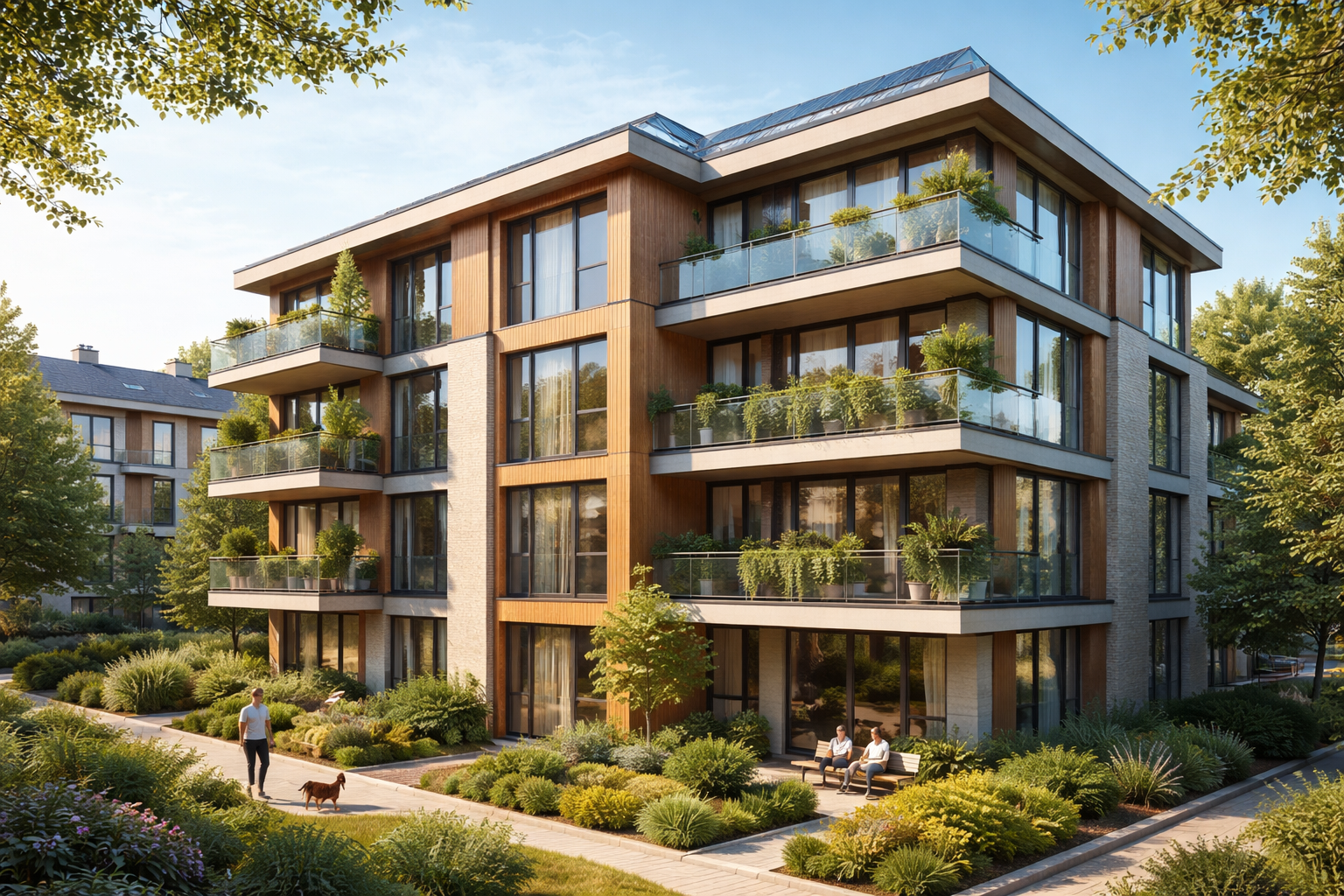
Passive house principles in UK green buildings are gaining strong momentum as the country accelerates its transition toward low-carbon, high-performance construction. Across the UK, developers, investors, and design teams increasingly seek solutions that reduce energy demand while maintaining comfort, quality, and long-term value.
As energy prices rise and climate targets become more demanding, performance-led design has become essential. Instead of compensating for inefficient buildings with complex systems, passive house principles focus on reducing energy demand at its source. Consequently, this approach aligns closely with the UK’s sustainability agenda and regulatory direction.
In this article, we explain how passive house principles apply to UK green buildings, why they are particularly effective in the UK climate, and how expert consultancy supports successful implementation.
Why Passive House Principles Matter in the UK
In the UK, buildings account for a significant proportion of national carbon emissions. Therefore, improving building performance represents one of the most effective ways to achieve net-zero targets.
Passive house principles in UK green buildings directly address this challenge. By prioritising insulation, airtightness, and ventilation efficiency, these principles dramatically reduce heating demand. As a result, buildings consume far less energy throughout their operational life.
Moreover, passive house buildings offer predictable performance. Unlike traditional compliance-based approaches, passive house design relies on measured outcomes rather than assumptions. This performance certainty is especially valuable for UK developers facing long-term operational and ESG obligations.
Core Passive House Principles in UK Green Buildings
Super-Insulated Building Envelopes
First and foremost, passive house principles require exceptionally high insulation standards. In the UK climate, this strategy helps maintain stable indoor temperatures during long heating seasons.
Well-insulated envelopes:
-
Minimise heat loss
-
Improve thermal comfort
-
Reduce energy bills over time
Because insulation works continuously, it delivers reliable performance without user intervention. Consequently, it forms the foundation of all passive house buildings.
Airtightness and Controlled Airflow
Airtightness plays a critical role in passive house principles in UK green buildings. Traditional UK construction often allows uncontrolled air leakage, which leads to energy loss and discomfort.
By contrast, passive house buildings control airflow intentionally. Design teams achieve this through airtight detailing and rigorous on-site testing. As a result, buildings perform consistently across seasons.
Importantly, airtightness does not mean poor air quality. Instead, it enables effective ventilation systems to operate efficiently.
Thermal Bridge-Free Design
Thermal bridges significantly undermine building performance. Therefore, passive house design eliminates them through continuous insulation and careful junction detailing.
In UK green buildings, thermal bridge-free design:
-
Prevents condensation and mould
-
Improves long-term durability
-
Enhances occupant wellbeing
Because these risks often emerge years after completion, early-stage design coordination becomes essential.
Mechanical Ventilation with Heat Recovery (MVHR)
Since passive house buildings are airtight, controlled ventilation becomes essential. For this reason, passive house principles require mechanical ventilation with heat recovery.
MVHR systems:
-
Supply fresh, filtered air continuously
-
Recover heat from exhaust air
-
Reduce heating demand substantially
In the UK, where indoor air quality concerns are growing, MVHR systems also improve health and comfort outcomes.
High-Performance Windows and Doors
High-performance glazing forms another key element of passive house principles in UK green buildings. Triple-glazed windows reduce heat loss while maximising useful solar gains.
When correctly specified, these systems:
-
Improve winter comfort
-
Prevent overheating
-
Reduce reliance on heating systems
Therefore, window orientation and shading strategies must align closely with the overall design approach.
Passive House Principles and UK Sustainability Frameworks
Passive house principles integrate effectively with wider green building strategies used in the UK. In practice, many projects combine passive house design with certifications such as BREEAM or LEED.
At ERKE, we support this integrated approach through our Green Building Consultancy services. By aligning performance targets with certification requirements, projects achieve both regulatory compliance and measurable sustainability outcomes.
Furthermore, passive house design complements life cycle assessment and sustainable material strategies, strengthening whole-building environmental performance.
Policy and Regulatory Alignment in the UK
Passive house principles strongly support current and future UK regulations. In particular, they align with:
-
Part L energy performance requirements
-
The Future Homes Standard
-
Local authority net-zero policies
Organisations such as the Passivhaus Trust actively promote these standards across the UK construction sector.
🔗 https://passivhaustrust.org.uk
At the same time, government guidance increasingly emphasises fabric-first solutions as the most reliable pathway to energy efficiency.
🔗 https://www.gov.uk/government/collections/energy-efficiency-statistics
Benefits for UK Residential and Commercial Projects
Passive house principles in UK green buildings deliver clear and measurable advantages.
Key benefits include:
-
Up to 90% reduction in heating demand
-
Lower operational costs
-
Improved asset value
-
Enhanced occupant comfort
-
Strong ESG and net-zero alignment
For commercial buildings, these benefits translate into improved productivity and reduced long-term risk. Meanwhile, residential projects benefit from comfort, affordability, and resilience against energy price volatility.
Why Consultancy Matters for Passive House Success
Although passive house principles appear straightforward, their successful application requires specialist expertise. Without early coordination, projects risk underperforming or incurring unnecessary costs.
ERKE supports UK projects by:
-
Integrating passive house principles into early design stages
-
Coordinating multidisciplinary teams
-
Aligning energy performance with investment and ESG goals
As a result, projects achieve genuine performance outcomes rather than theoretical compliance.
Frequently Asked Questions (FAQ)
What are passive house principles in UK green buildings?
They are performance-based design strategies that minimise energy demand through insulation, airtightness, ventilation efficiency, and thermal optimisation.
Are passive house buildings suitable for the UK climate?
Yes. Passive house principles work particularly well in the UK’s cool and temperate climate by reducing heating demand while maintaining comfort.
Is passive house certification mandatory in the UK?
No. However, many UK developers adopt it voluntarily as a best-practice standard aligned with future regulations.
Can passive house principles be applied to non-residential buildings?
Yes. Offices, schools, healthcare facilities, and mixed-use developments across the UK successfully use passive house methodologies.
Conclusion: Performance Is the Future of UK Green Buildings
As sustainability expectations continue to rise, passive house principles in UK green buildings offer a proven pathway to energy efficiency, carbon reduction, and long-term value. When applied early and supported by expert consultancy, these principles deliver buildings that perform reliably throughout their lifecycle.
If you are planning a project and want to apply passive house principles in UK green buildings, ERKE provides expert consultancy tailored to the UK market.
👉 Contact our team today:
https://erkeconsultancy.com/contact-us/
Let’s deliver buildings that perform—for people, climate, and long-term investment value.