
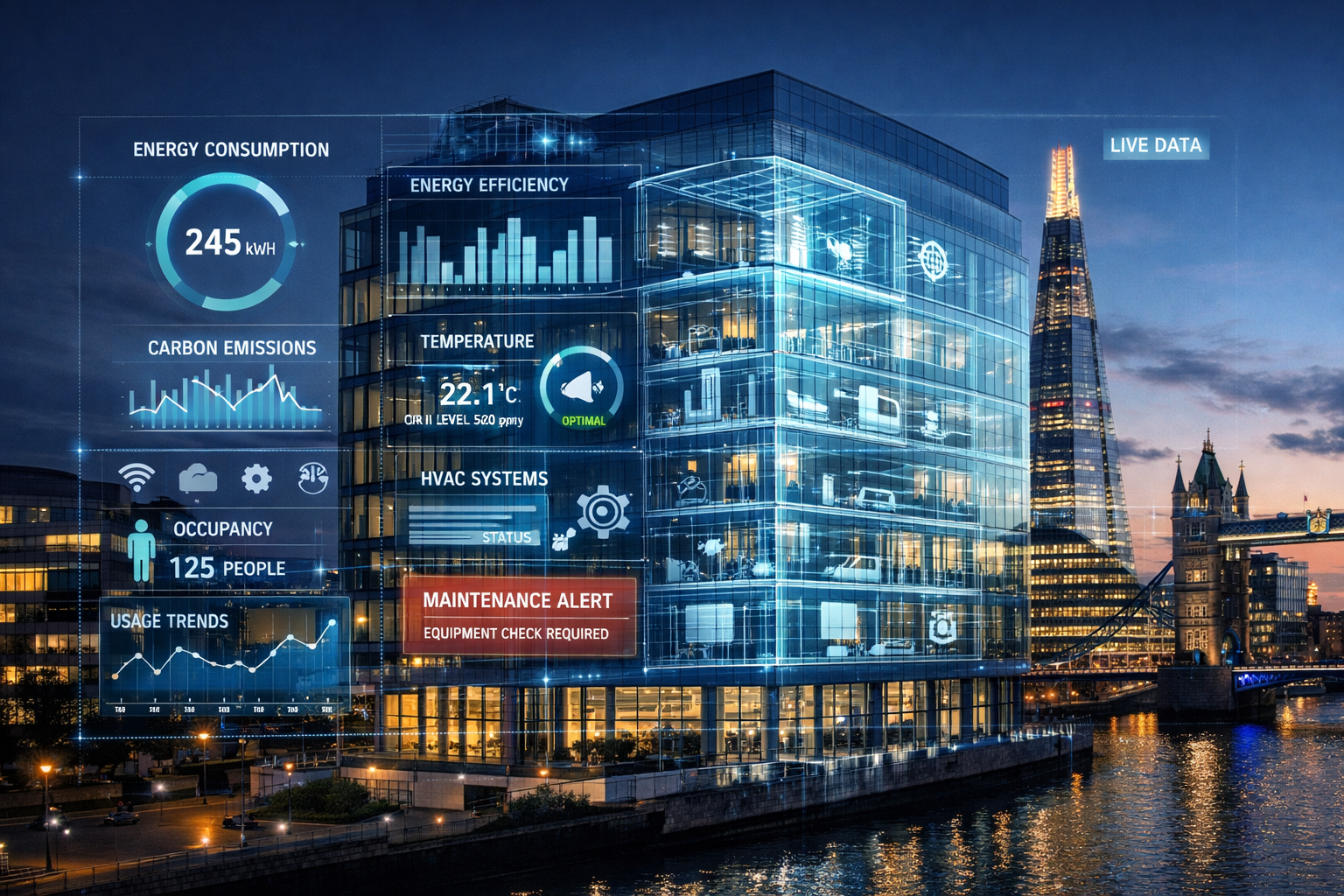
The question of how digital twins improve building performance in the UK has become increasingly important as the built environment faces stricter energy regulations, ambitious net-zero targets, and rising operational costs. Across commercial, public, and mixed-use developments, digital twin technology is emerging as a powerful tool to optimise building performance throughout the entire lifecycle.
In the UK, where frameworks such as the UK Net Zero Strategy, Part L of the Building Regulations, and NABERS UK are reshaping expectations, digital twins provide a data-driven foundation for smarter, more resilient buildings. This article explores how digital twins improve building performance in the UK, from design and construction to operation and long-term asset value.
What Is a Digital Twin in the UK Building Context?
A digital twin is a dynamic virtual replica of a physical building, continuously updated with real-time and historical data. Unlike static BIM models, digital twins integrate operational data such as energy use, indoor environmental quality, occupancy patterns, and system performance.
In the UK, digital twins are increasingly aligned with:
-
Building Management Systems (BMS)
-
IoT sensors and smart meters
-
Energy and carbon reporting frameworks
-
Asset performance and facilities management platforms
This integration allows stakeholders to simulate, monitor, and optimise building performance with a level of precision that was previously unattainable.
How Digital Twins Improve Building Performance in the UK Design Phase
Understanding how digital twins improve building performance in the UK begins at the design stage. Early-stage modelling enables design teams to test performance scenarios before construction begins.
Performance-Driven Design Decisions
Digital twins allow engineers and sustainability consultants to:
-
Simulate energy demand under UK climate conditions
-
Compare façade, HVAC, and lighting strategies
-
Evaluate operational carbon and energy intensity targets
These simulations help ensure compliance with UK regulations and voluntary schemes such as BREEAM and NABERS UK before costly design changes occur later.
Construction Accuracy and Risk Reduction
Another way digital twins improve building performance in the UK is by reducing the gap between design intent and as-built reality.
During construction, digital twins:
-
Validate installation quality against performance targets
-
Identify clashes or inefficiencies early
-
Support commissioning and handover processes
This results in fewer defects, smoother commissioning, and a building that performs closer to its original design assumptions from day one.
Operational Optimisation Through Digital Twins in the UK
The most significant impact of digital twins on building performance in the UK is realised during operation, where buildings spend most of their lifecycle.
Real-Time Energy and Carbon Performance
Digital twins provide continuous insight into:
-
Energy consumption trends
-
Carbon emissions performance
-
Peak load and system inefficiencies
This capability supports compliance with UK energy performance reporting and enables proactive energy optimisation rather than reactive fixes.
According to guidance from the UK Green Building Council (UKGBC), data-driven building operation is essential to achieving net-zero carbon goals across the UK built environment.
🔗 https://www.ukgbc.org
Predictive Maintenance and Asset Longevity
A key reason how digital twins improve building performance in the UK is gaining attention is their role in predictive maintenance.
By analysing performance data, digital twins can:
-
Predict equipment failure before it occurs
-
Optimise maintenance schedules
-
Extend asset lifespan and reduce downtime
For large commercial and public-sector buildings in the UK, this translates into significant cost savings and improved occupant comfort.
Enhancing Occupant Comfort and Wellbeing
Building performance in the UK is no longer measured by energy alone. Occupant comfort, indoor air quality, and wellbeing are now central performance indicators.
Digital twins help:
-
Monitor thermal comfort and air quality
-
Align building operation with occupancy patterns
-
Improve user satisfaction and productivity
This is particularly relevant for offices and educational buildings responding to post-pandemic expectations for healthier indoor environments.
Digital Twins and UK Sustainability Certifications
Another critical aspect of how digital twins improve building performance in the UK is their alignment with sustainability and performance certifications.
Digital twins support:
-
Ongoing performance tracking for NABERS UK
-
Energy and carbon verification for BREEAM In-Use
-
Data transparency for ESG reporting
For organisations pursuing structured sustainability strategies, digital twins act as a single source of truth across performance metrics.
To understand how performance-based approaches integrate with wider sustainability strategies, explore ERKE’s consultancy services:
🔗 https://erkeconsultancy.com/green-building-consultancy/
Supporting Net Zero and Regulatory Compliance in the UK
The UK’s pathway to net zero requires operational performance, not just design compliance. Digital twins play a critical role by enabling:
-
Continuous improvement rather than one-off compliance
-
Verification of operational energy and carbon data
-
Scenario testing for retrofit and decarbonisation strategies
Guidance from the UK Government’s Net Zero Strategy highlights the importance of digital tools in managing building emissions at scale.
🔗 https://www.gov.uk/government/publications/net-zero-strategy
Long-Term Value and Asset Resilience
From an investor and asset owner perspective, understanding how digital twins improve building performance in the UK is also about long-term value.
Digital twins:
-
Improve asset transparency
-
Reduce operational risk
-
Increase resilience to regulatory and market changes
High-performing, data-driven buildings are more attractive to tenants, investors, and regulators alike.
Frequently Asked Questions (FAQ)
What types of buildings in the UK benefit most from digital twins?
Commercial offices, healthcare facilities, educational buildings, and large mixed-use developments gain the most value due to their complexity and operational demands.
Are digital twins only suitable for new buildings?
No. Digital twins can be applied to existing buildings through retrofitted sensors and system integration, making them highly relevant for the UK’s ageing building stock.
How do digital twins support UK energy regulations?
They provide continuous performance data, helping buildings stay compliant with Part L, NABERS UK, and future performance-based regulations.
Do digital twins replace building management systems?
No. Digital twins enhance BMS by adding analytics, predictive capabilities, and scenario modelling on top of existing systems.
Conclusion: Why Digital Twins Are Transforming UK Building Performance
As the UK construction and real estate sectors move toward performance-based outcomes, the importance of understanding how digital twins improve building performance in the UK continues to grow. By connecting design intent with operational reality, digital twins enable smarter decisions, lower emissions, improved comfort, and long-term asset resilience.
Digital twins are no longer a future concept—they are a practical solution for organisations seeking measurable, verifiable, and sustainable building performance across the UK.
If you are exploring how digital twins improve building performance in the UK and want expert guidance tailored to your project or portfolio, ERKE Consultancy can support you from strategy to implementation.
👉 Contact our team today to discuss digital twin–enabled performance optimisation:
🔗 https://erkeconsultancy.com/contact-us/