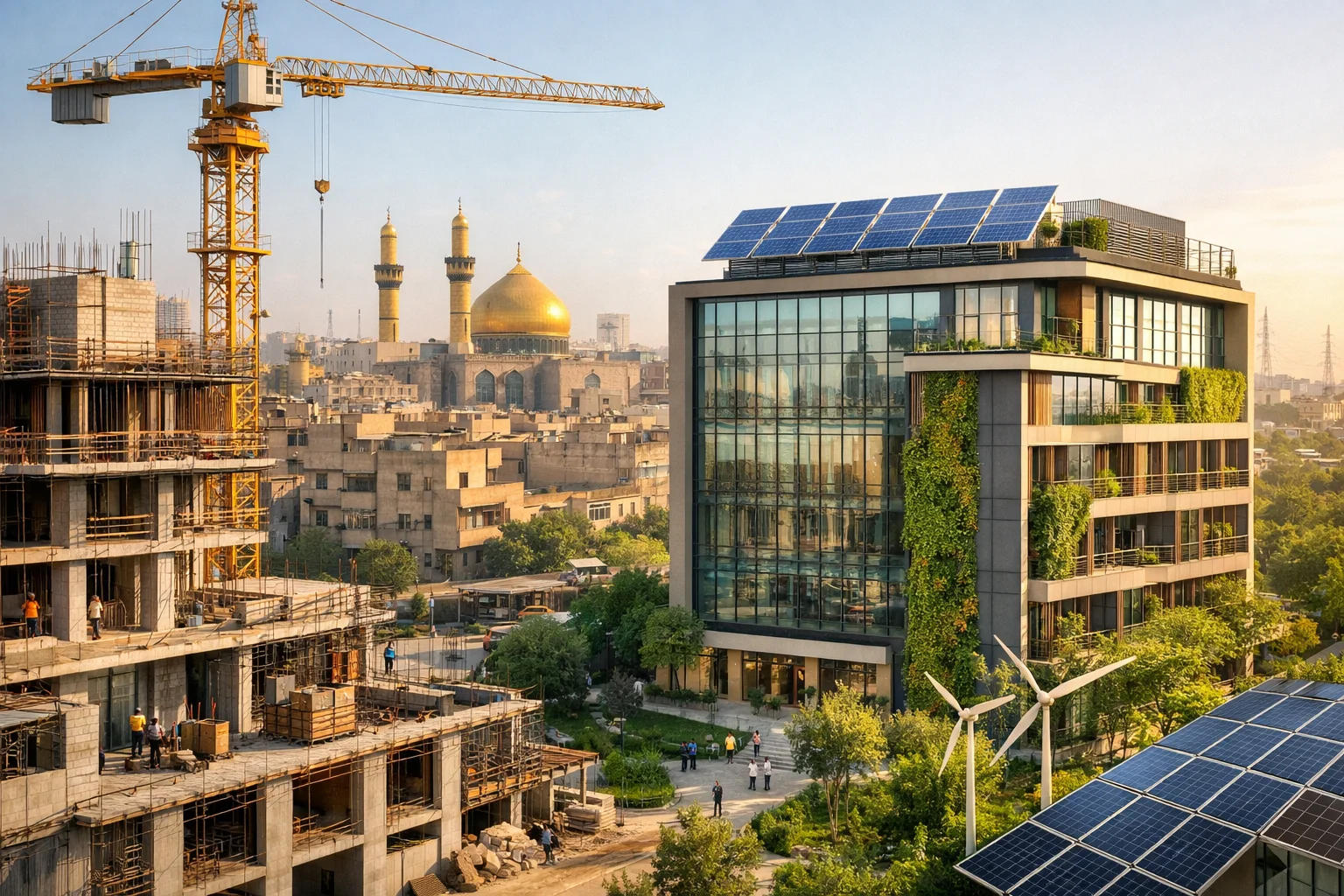
Green standards in Iraq are becoming an increasingly important topic as the country enters a new phase of reconstruction, urban growth, and international investment. With rising global pressure for sustainability, many developers and public institutions in Iraq are showing interest in international green building standards such as LEED, EDGE, and similar frameworks. However, the practical application of these standards within the Iraqi context presents unique technical, regulatory, and economic challenges.
This article explores the key challenges of applying international green standards in Iraq, explains why these obstacles exist, and outlines how international consultancy expertise can help bridge the gap between global sustainability requirements and local realities.
Understanding International Green Standards
International green building standards are structured frameworks designed to reduce environmental impact, improve energy efficiency, and enhance occupant well-being. Systems such as LEED (Leadership in Energy and Environmental Design) evaluate buildings across multiple categories, including energy, water, materials, indoor environmental quality, and site sustainability.
While these standards are globally recognized, they are primarily developed based on regulatory environments, climatic data, and market conditions found in North America, Europe, or advanced Asian economies. This mismatch is at the core of many challenges related to green standards in Iraq.
For a deeper understanding of professional green building advisory services, you may explore ERKE’s global expertise in green building consultancy:
👉 https://erkeconsultancy.com/green-building-consultancy/
Regulatory and Policy Challenges in Iraq
Lack of Local Alignment with Green Standards
One of the main challenges in applying green standards in Iraq is the absence of nationally integrated sustainability regulations. Local building codes often do not align with international certification requirements, creating conflicts between mandatory regulations and voluntary green criteria.
Developers may face uncertainty regarding:
-
Approval processes
-
Permitting timelines
-
Conflicting technical requirements
Without government-level integration, green certification often remains optional and dependent on private-sector motivation.
Limited Institutional Capacity
Public institutions responsible for construction oversight may lack technical familiarity with international sustainability frameworks. This can lead to delays, misinterpretations, or resistance during project reviews, increasing both risk and cost for investors.
Technical and Infrastructure Barriers
Energy Infrastructure Constraints
International green standards place strong emphasis on energy efficiency, renewable energy integration, and performance modeling. However, Iraq’s energy infrastructure faces challenges such as:
-
Grid instability
-
Limited renewable integration
-
Dependence on fossil-fuel-based power generation
Meeting energy performance benchmarks under green standards in Iraq often requires customized modeling strategies rather than standard assumptions used in developed markets.
Water Efficiency and Resource Management
Water efficiency is another critical pillar of green certification. Iraq faces water scarcity issues, aging infrastructure, and limited access to advanced water-saving technologies. International benchmarks may require systems that are not readily available in the local supply chain, complicating compliance efforts.
Material Availability and Supply Chain Limitations
Scarcity of Certified Sustainable Materials
Many international green standards require documentation such as Environmental Product Declarations (EPDs), recycled content verification, or low-emission material certifications. In Iraq, access to locally produced, certified materials is limited.
As a result:
-
Projects may rely heavily on imported materials
-
Costs increase significantly
-
Documentation becomes complex
This material gap is one of the most practical barriers to implementing green standards in Iraq.
Lack of Local Manufacturers’ Documentation
Even when materials are locally available, manufacturers may not provide the required environmental documentation, making compliance difficult without external consultancy support.
Economic and Financial Challenges
Higher Initial Investment Perception
Although green buildings often deliver long-term operational savings, many stakeholders in Iraq focus on initial construction costs. International green certification is sometimes perceived as an added expense rather than a value-enhancing investment.
Key financial concerns include:
-
Certification fees
-
Specialized consultants
-
Imported systems and materials
Without clear lifecycle cost analysis, green standards may appear economically unattractive.
Limited Green Financing Mechanisms
In many regions, green buildings benefit from incentives, tax reductions, or favorable financing. In Iraq, such mechanisms are still emerging, reducing financial motivation for adopting green standards in Iraq.
For broader global insight into sustainable construction financing and development challenges, the World Bank provides valuable regional analysis:
👉 https://www.worldbank.org/en/country/iraq
Knowledge Gaps and Human Capital Challenges
Limited Local Expertise
International green standards require trained professionals such as accredited LEED consultants, energy modelers, and sustainability coordinators. The shortage of locally certified experts in Iraq increases dependency on international consultants.
Training and Capacity Building Needs
Contractors, engineers, and facility managers may lack hands-on experience with green construction practices. This can affect construction quality, commissioning processes, and long-term performance.
Organizations like the U.S. Green Building Council offer foundational resources on global green building practices:
👉 https://www.usgbc.org
Cultural and Market Adaptation Issues
Perception of Sustainability
In some cases, sustainability is still viewed as a “luxury feature” rather than a strategic necessity. Aligning green standards with local priorities—such as energy security, operational resilience, and occupant comfort—is essential for wider adoption.
Adapting Standards to Local Climate and Use Patterns
Iraq’s climate conditions, usage patterns, and operational realities differ significantly from the regions where most international standards originate. Applying green standards in Iraq successfully requires contextual adaptation rather than rigid compliance.
Strategic Solutions for Applying Green Standards in Iraq
Contextualized Green Strategies
Successful projects adapt international frameworks to local conditions through:
-
Customized energy modeling
-
Climate-responsive design strategies
-
Alternative compliance paths
Integrated Consultancy Approach
An experienced sustainability consultancy can act as a bridge between global standards and local execution, ensuring feasibility without compromising certification goals.
Early-Stage Sustainability Integration
Introducing sustainability strategies at the concept design stage significantly reduces cost and complexity. Early integration is critical for overcoming the challenges of green standards in Iraq.
Frequently Asked Questions (FAQ)
1. Are international green standards applicable in Iraq?
Yes, but they must be adapted to local regulations, climate conditions, and infrastructure realities to be effective.
2. What is the biggest challenge in applying green standards in Iraq?
The main challenges include regulatory misalignment, limited certified materials, and lack of local technical expertise.
3. Do green buildings increase construction costs in Iraq?
Initial costs may be higher, but long-term operational savings and asset value often offset the investment.
4. Which projects benefit most from green certification in Iraq?
Large commercial, mixed-use, healthcare, and international investment projects benefit the most due to long-term performance and credibility gains.
Conclusion and Call to Action
The adoption of green standards in Iraq is both a challenge and an opportunity. While regulatory, technical, and economic barriers exist, they are not insurmountable. With the right strategy, expertise, and early planning, international green standards can be successfully implemented to support Iraq’s sustainable development goals.
Ready to Overcome These Challenges?
If your project in Iraq is facing challenges related to international green standards, ERKE offers globally proven sustainability consultancy tailored to local conditions.
👉 Contact our expert team today:
https://erkeconsultancy.com/contact-us/
Let us help you turn sustainability challenges into long-term value.