
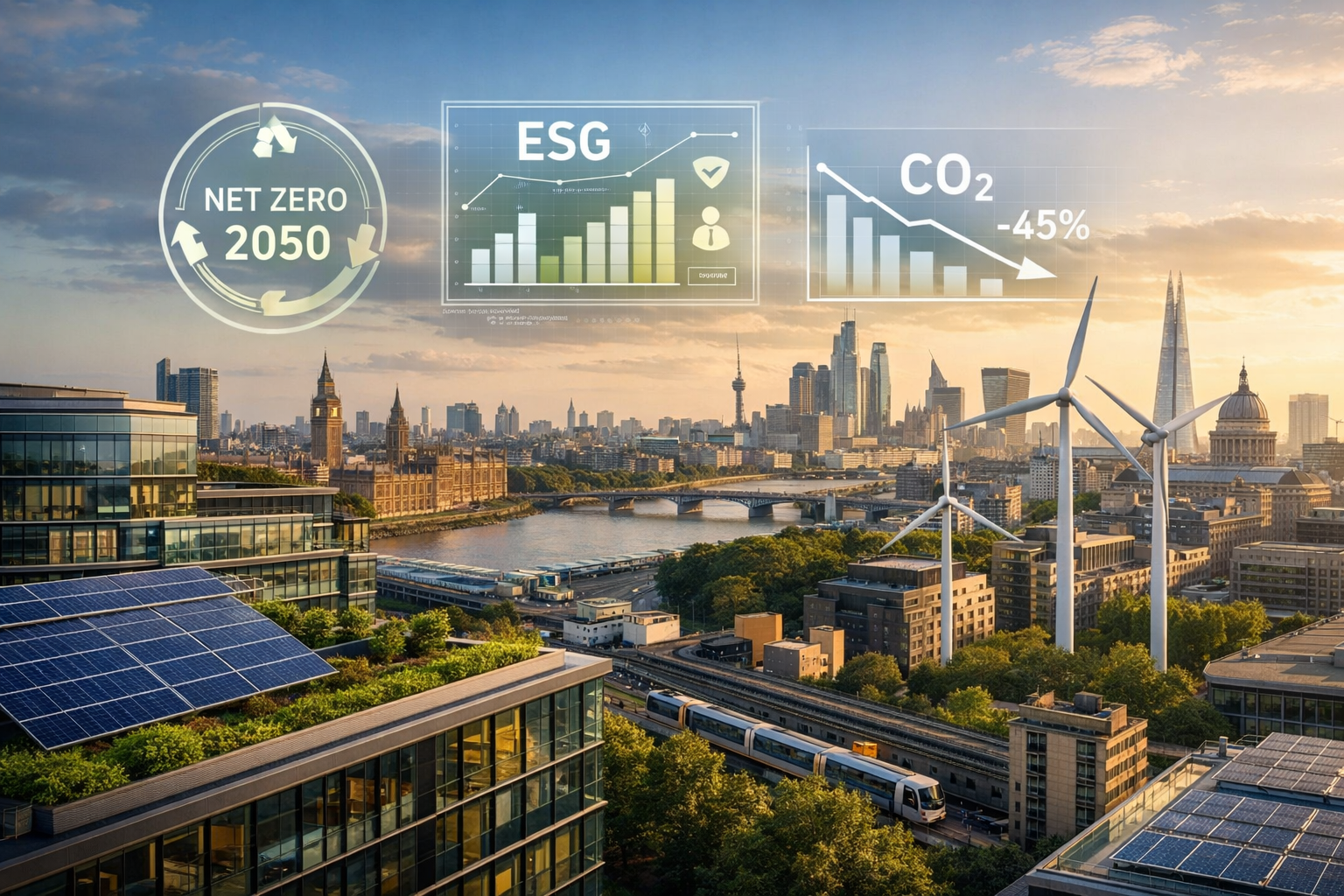
In today’s regulatory and economic landscape, a future-proof sustainability strategy in the UK has become a strategic necessity rather than a long-term aspiration. As sustainability expectations continue to evolve, UK organisations must move beyond short-term compliance and adopt strategies that remain resilient under regulatory, financial, and environmental pressure.
From a strategic perspective, a future-proof sustainability strategy in the UK connects environmental performance with governance, risk management, and long-term business value. Rather than focusing solely on carbon targets, organisations increasingly align sustainability with decision-making, investment planning, and asset performance.
This article explains what makes a sustainability strategy future-proof in the UK, while also outlining the structural elements that allow organisations to adapt confidently to future change.
The UK Context: Why Sustainability Strategies Must Be Built for the Future
The UK operates within one of the most mature sustainability ecosystems in the world. Binding climate legislation, advanced disclosure requirements, and increasing stakeholder scrutiny mean that sustainability strategies must be designed for continuous evolution.
A future-proof sustainability strategy UK organisations need must respond to:
-
Net Zero 2050 commitments
-
Increasing ESG disclosure requirements
-
Climate risk and resilience expectations
-
Investor and supply-chain sustainability criteria
Strategies that focus only on near-term targets often become obsolete within a few years. Future-proofing requires anticipating directional change, not just meeting current benchmarks.
Strategic Alignment: Connecting Sustainability to Business Objectives
One of the clearest indicators of a future-proof sustainability strategy in the UK is alignment with core business strategy.
Rather than treating sustainability as a parallel initiative, future-ready organisations integrate sustainability into:
-
Corporate decision-making
-
Capital expenditure planning
-
Risk and opportunity assessment
-
Portfolio and asset management
This alignment ensures that sustainability remains relevant even as leadership, markets, or regulations change. Sustainability becomes a driver of business resilience, not a compliance burden.
Regulatory Intelligence: Preparing for What Comes Next
UK sustainability regulation is not static. A future-proof sustainability strategy UK organisations rely on must be designed with regulatory foresight.
Key considerations include:
-
Anticipating stricter carbon reporting rules
-
Preparing for enhanced climate risk disclosures
-
Aligning early with international sustainability standards
Organisations that monitor regulatory signals and integrate them early gain a competitive advantage, reducing transition risks and future compliance costs.
🔗 UK Climate Change Act and Net Zero Framework
https://www.legislation.gov.uk/ukpga/2008/27/contents
Carbon Strategy Beyond Offsetting
A defining feature of a future-proof sustainability strategy in the UK is how it addresses carbon management.
Rather than relying heavily on offsets, future-ready strategies:
-
Prioritise operational carbon reduction
-
Address embodied carbon and lifecycle impacts
-
Integrate carbon metrics into design and procurement
-
Use offsets only as a last resort
This approach aligns with emerging best practice and avoids the reputational and regulatory risks associated with over-reliance on offsetting.
Data-Driven Sustainability: From Reporting to Intelligence
What makes a sustainability strategy future-proof in the UK is not the volume of reporting, but the quality and usability of data.
Future-proof strategies are built on:
-
Reliable sustainability KPIs
-
Transparent data collection processes
-
Third-party verification
-
Continuous performance monitoring
As AI-driven assessment tools and automated ESG screening become more prevalent, organisations with structured, high-quality data will be best positioned to maintain credibility.
Governance and Accountability as Long-Term Enablers
Strong governance is essential for sustainability strategies that endure.
A future-proof sustainability strategy UK organisations implement typically includes:
-
Board-level accountability
-
Clear ownership of sustainability objectives
-
Integration with enterprise risk management
-
Regular strategic review cycles
Without governance, even the most ambitious sustainability plans risk losing momentum over time.
Built Environment and Asset Resilience
In the UK, a significant portion of sustainability impact and risk is tied to the built environment.
Future-proof sustainability strategies consider:
-
Energy performance and retrofit readiness
-
Climate resilience of assets
-
Long-term operational efficiency
-
Asset value under future regulation
At ERKE Consultancy, sustainability strategies are closely aligned with green building and asset performance principles to ensure long-term resilience. Learn more about our integrated services here:
🔗 https://erkeconsultancy.com/what-we-do/
Supply Chain Readiness and Scope 3 Emissions
For many UK organisations, Scope 3 emissions represent the largest sustainability challenge.
A future-proof sustainability strategy UK businesses adopt must:
-
Engage suppliers proactively
-
Set clear sustainability expectations
-
Improve transparency across the value chain
-
Reduce dependency on high-risk materials and processes
This approach strengthens not only environmental performance but also supply-chain resilience.
Technology as a Future-Proofing Tool
Technology plays a critical role in ensuring sustainability strategies remain adaptable.
Future-ready organisations use:
-
Digital ESG platforms
-
Carbon and energy modelling tools
-
Scenario analysis for climate risks
-
Automated reporting systems
Technology enables organisations to respond quickly to regulatory change and emerging sustainability risks.
Frequently Asked Questions (FAQ)
What defines a future-proof sustainability strategy in the UK?
It is a strategy designed to adapt to changing regulation, climate risks, and market expectations while delivering long-term business value.
How is a UK sustainability strategy different from a global one?
UK strategies must align with local legislation, disclosure frameworks, and Net Zero commitments, requiring a more tailored approach.
Is future-proofing sustainability only about environmental impact?
No. It also includes governance, data, financial resilience, and long-term asset performance.
How often should sustainability strategies be reviewed?
Best practice is annual strategic review with continuous monitoring and adjustment.
Conclusion: Designing Sustainability for the Long Term
A future-proof sustainability strategy in the UK is not static. It is a living framework that evolves with regulation, technology, and societal expectations. Organisations that invest in strategic alignment, governance, and data today will be better prepared for tomorrow’s challenges.
If your organisation is looking to develop a future-proof sustainability strategy in the UK, ERKE Consultancy provides expert-led, integrated support across sustainability strategy, ESG, carbon management, and the built environment.
👉 Speak with our team today to future-proof your sustainability approach:
🔗 https://erkeconsultancy.com/contact-us/