
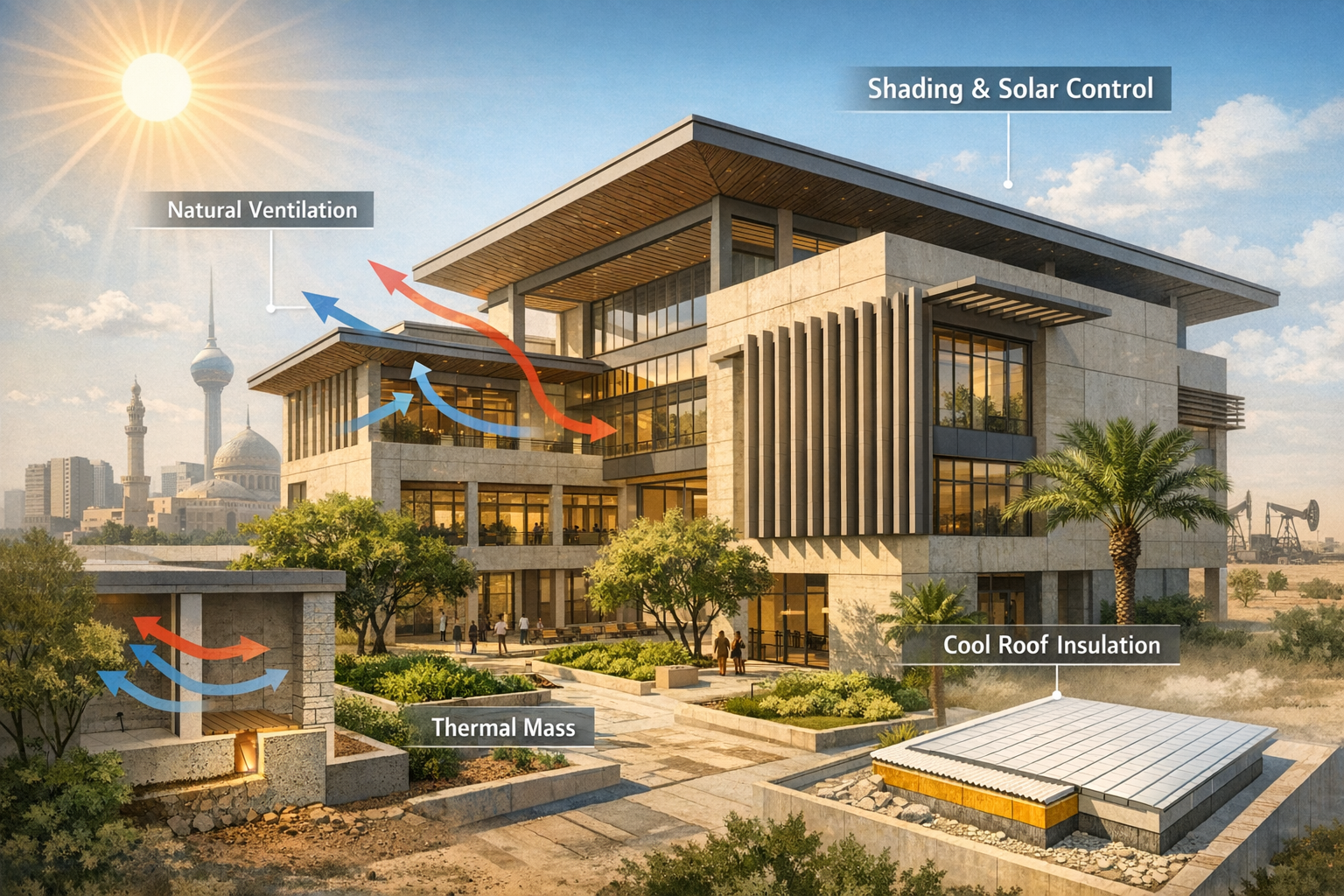
Passive design Iraq is one of the fastest, most cost-effective ways to reduce electricity stress without waiting for major grid upgrades. In a country where peak summer demand can overwhelm supply, lowering cooling loads at the building level directly reduces generator dependence, fuel burn, operating cost, and occupant discomfort—while improving resilience during outages.
Iraq has strong solar potential and a power system under pressure, with a demand profile increasingly dominated by cooling needs. The World Bank has also highlighted deep sector inefficiencies and the urgency of tackling climate and development challenges together. For developers, owners, and public institutions, the strategic question becomes: How can buildings demand less energy to stay comfortable—especially in extreme heat? The answer is a disciplined package of passive measures tailored to Iraq’s climate zones, construction realities, and operations.
Why Iraq’s buildings become “energy amplifiers” in summer
In much of Iraq, summer temperatures are high enough that air-conditioning becomes a health and productivity requirement—not a luxury. When building envelopes are unprotected (unshaded glass, poorly insulated roofs, leaky windows), cooling systems must fight constant heat gain. That creates three compounding problems:
-
Peak-load spikes (midday and late afternoon) when the grid is already strained.
-
Reliance on backup generators (high operating cost, maintenance burden, air pollution).
-
Indoor comfort instability during outages, especially in schools, hospitals, and offices.
Passive design doesn’t eliminate mechanical cooling in every case, but it can shrink cooling demand dramatically, enabling smaller HVAC systems, better comfort, and more stable operation—even when power quality fluctuates.
Passive design Iraq: the principles that cut cooling demand first
Passive strategies work best when applied as a coordinated set—not as isolated upgrades. The goal is simple: block heat from entering, remove heat naturally when possible, and stabilize indoor temperatures.
1) Passive design Iraq through solar control and external shading
In Iraq’s sun-intense conditions, solar radiation through windows can be a dominant driver of cooling loads. External shading is often the highest-impact first step because it prevents heat gain before it reaches the glass.
Practical shading measures for Iraqi projects
-
Deep overhangs on south façades (effective against high-angle sun).
-
Vertical fins on east/west façades (better against low-angle morning/afternoon sun).
-
Shading screens (mashrabiya-inspired) that preserve daylight while cutting glare.
-
Arcades and recessed windows that create permanent shade.
This approach is especially valuable for offices, retail, and public buildings where large glazed areas are common. It also improves occupant comfort by reducing glare—often allowing higher thermostat setpoints without complaints.
2) Passive design Iraq via roof and wall performance
Roofs are frequently the “largest solar collector” in low- to mid-rise Iraqi buildings. A roof that overheats all day radiates heat inward long after sunset, keeping indoor temperatures elevated.
High-return envelope moves
-
Cool roofs (high reflectance, high emissivity coatings).
-
Roof insulation sized for hot climates (continuous insulation, minimized thermal bridges).
-
Wall insulation + airtightness to reduce infiltration of hot air and dust.
-
High-performance glazing where glazing is necessary (low solar heat gain coefficient + appropriate U-values).
Even with limited budget, targeting the roof and key façades can deliver outsized benefits.
3) Passive design Iraq using thermal mass and night purging
Many Iraqi regions experience meaningful day-night temperature swings (especially in drier areas). Where nights cool down enough, buildings can “store coolth” by using thermal mass (concrete, masonry) and flushing heat out at night.
How to use mass effectively
-
Keep thermal mass inside the insulated envelope (so it stabilizes indoor temperature).
-
Enable night ventilation (secure openings, ventilation paths, or controlled fans) to purge heat.
-
Prevent daytime heat gain with shading—thermal mass works best when the building isn’t constantly reheated by sun.
This strategy is particularly relevant to schools and offices that operate mostly during daytime.
4) Passive design Iraq with climate-driven natural ventilation (when safe and feasible)
Natural ventilation is not a one-size-fits-all solution in Iraq due to dust events, air quality variations, security constraints, and extremely hot hours. But in shoulder seasons, evenings, or specific building types (courtyards, atria, semi-outdoor circulation), it can significantly reduce mechanical cooling hours.
Design moves that make ventilation reliable
-
Courtyard planning to create pressure differences and shaded microclimates.
-
Stack ventilation paths (high exhaust openings, shaded low inlets).
-
Cross-ventilation with correct room depths and aligned openings.
-
Filtered intake options to manage dust and particulates when needed.
Comfort targets should be validated using recognized guidance such as ASHRAE Standard 55 for thermal environmental conditions.
Passive design Iraq in practice: a “load reduction stack” for Iraqi buildings
For decision-makers who want a straightforward roadmap, here is a practical sequence that consistently reduces peak cooling demand:
-
Shading first (especially east/west)
-
Roof performance (cool roof + insulation)
-
Airtightness + controlled ventilation
-
Glazing strategy (right glass, right window-to-wall ratio)
-
Thermal mass + night purge (where climate supports it)
-
Daylight optimization to reduce lighting heat and improve usability
-
Efficient HVAC sizing after loads are reduced (smaller, more stable, less capex)
This sequence matters: if you install larger HVAC first, you lock in higher cost and higher peak demand. Passive-first design shrinks the problem before mechanical systems are selected.
How passive design supports Iraq’s energy resilience and project economics
Passive design strategies solve energy problems in Iraq not only by reducing kWh consumption, but by improving system stability:
-
Lower peak demand reduces the probability of brownouts and transformer stress.
-
Smaller HVAC systems reduce capital cost, spare parts needs, and maintenance complexity.
-
Improved comfort during outages extends the “safe indoor time” without power.
-
Better indoor environmental quality supports productivity and occupant satisfaction.
At the national level, Iraq’s energy context includes both fossil resource dominance and large renewable potential, making demand-side efficiency a crucial complement to supply-side investment.
For broader context on Iraq’s energy and climate-development pathway, see:
-
World Bank – Iraq Country Climate and Development Report: https://www.worldbank.org/en/country/iraq/publication/iraq-country-climate-and-development-report
-
IEA – Iraq energy country profile: https://www.iea.org/countries/iraq
FAQ: Passive design and Iraq’s energy challenge
1) What are the most effective passive strategies for Iraq’s hot climate?
For most Iraqi projects, the biggest gains come from external shading, roof insulation/cool roofs, airtightness, and right-sized glazing. Thermal mass + night purging can add major value where nighttime conditions support it.
2) Can passive design eliminate air-conditioning in Iraq?
In many building types, full elimination is unrealistic during peak summer. However, passive design can reduce cooling loads enough to use smaller systems, fewer operating hours, and more stable comfort—especially when paired with efficient HVAC and controls.
3) Does passive design help during power outages?
Yes. A better envelope and reduced heat gains mean indoor temperatures rise more slowly during outages. That resilience can be critical for healthcare, education, and high-occupancy facilities.
4) How do we prove the energy impact for investors or public tenders?
Use climate-based energy modeling and comfort checks (commonly aligned with standards such as ASHRAE thermal comfort guidance). For high-stakes projects, quantify peak-load reduction and lifecycle cost savings, not just annual kWh.
Ready to apply passive design in Iraq?
If you’re planning a development in Iraq and want Passive design Iraq strategies translated into measurable load reductions, comfort targets, and buildable details, ERKE can support you from early-stage concept through performance verification.
Contact our team to discuss climate-responsive design, energy modeling, and envelope/HVAC optimization for your project:
https://erkeconsultancy.com/contact-us/