Choosing a LEED Consultant Czech Republic project teams can trust often decides whether certification feels clear or chaotic. A strong LEED Consultant Czech Republic partner does more than collect points. That partner helps owners align sustainability targets, design decisions, documentation, and long-term asset value from the first workshop onward.
For developers, investors, architects, and contractors in the Czech Republic, LEED can support healthier indoor spaces, lower operating costs, and a stronger market position. The U.S. Green Building Council describes LEED as the world’s most widely recognized green building rating system, with pathways for new construction, interiors, existing buildings, neighborhoods, homes, and cities. That flexibility makes LEED relevant for offices, hospitality, residential schemes, industrial assets, and tenant fit-outs across the Czech market.
Why a LEED Consultant Czech Republic Partner Adds Real Value
A good consultant turns a complex certification framework into a practical project roadmap. Instead of reacting to credit requirements late in design, the team can make informed choices early. That shift protects budget, reduces redesign risk, and helps everyone understand which credits matter most for the building’s goals. The official Guide to LEED Certification exists for this reason: the process works best when teams follow a clear structure, understand requirements, and prepare documentation with discipline.
That matters even more in a market where sustainability expectations keep rising. The Czech Green Building Council states that it has been leading the Czech construction industry toward sustainability for more than a decade. In practice, this means project teams in the Czech Republic now face stronger expectations around energy performance, user well-being, resilience, transparency, and future readiness. A capable consultant helps translate those expectations into design actions that teams can actually deliver.
What a LEED consultant actually does
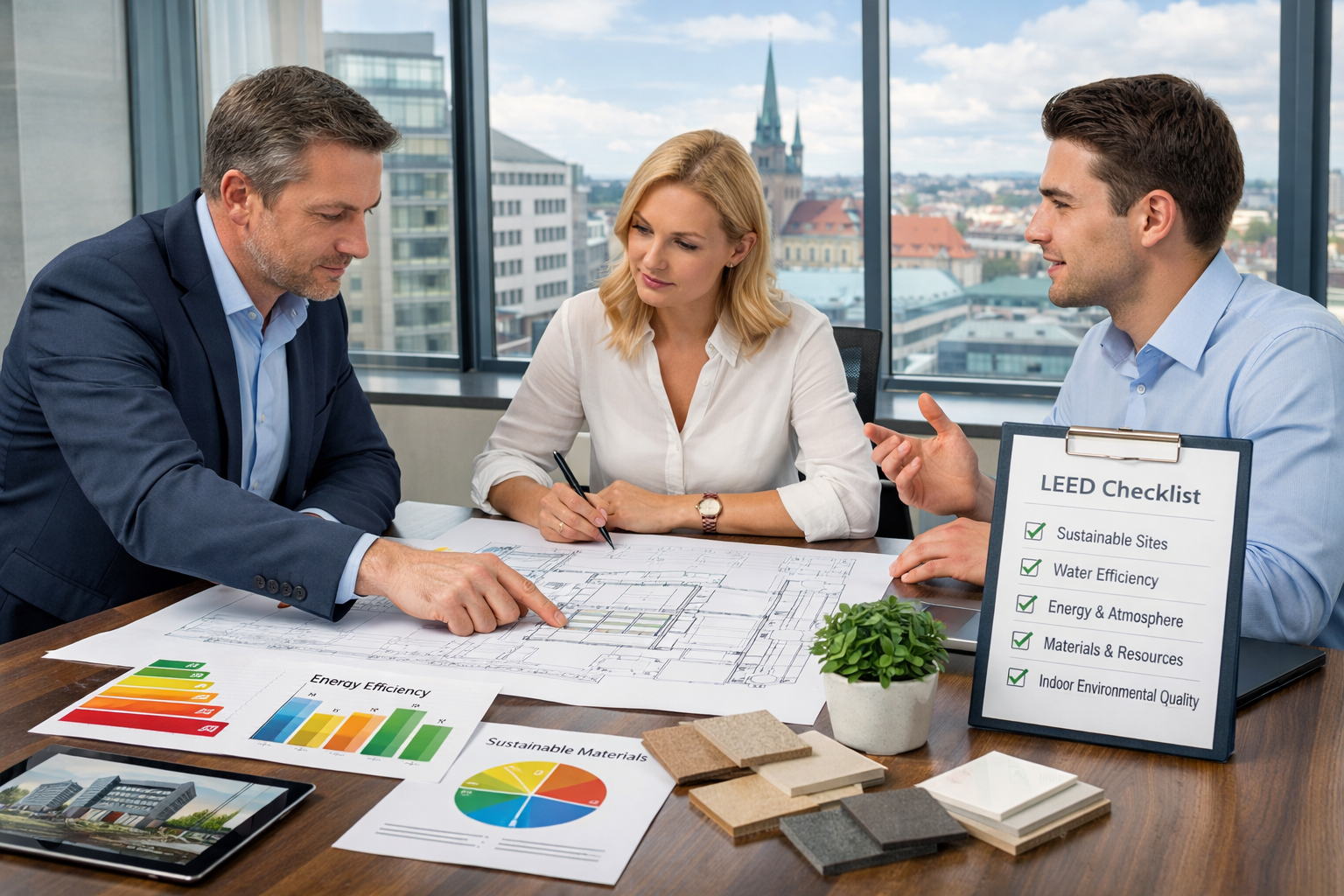
A LEED consultant starts by selecting the right rating system and project path. According to USGBC, LEED applies across different building types and phases, while certification requires teams to satisfy prerequisites and earn points across defined credit categories. After that, the consultant usually maps target credits, coordinates workshops, advises the design team, tracks evidence, manages submissions, and supports the review process carried out by GBCI.
At ERKE, this role connects directly with our LEED consulting and green building consultancy services. Those pages describe support that covers strategy, design alignment, stakeholder coordination, and certification management. They also show that green building work should not sit in a silo. The best results come when certification goals support real performance in energy, water, materials, waste, and indoor environmental quality.
Choosing the right LEED Consultant Czech Republic team
Not every consultant offers the same depth. Look for a team that understands both the technical side and the delivery side of construction. The consultant should know how to read drawings, challenge unrealistic credit assumptions, coordinate with architects and engineers, and keep documentation moving before deadlines become a problem. Strong communication matters just as much as technical knowledge. A project team should always know what is required, who owns each task, and what evidence must be prepared next.
Credentials also matter. USGBC explains that a LEED AP with specialty is an advanced professional credential tied to expertise in a LEED rating system and the certification process. That does not replace project experience, but it does signal serious competence. When you combine proven delivery experience with credentialed expertise, you reduce guesswork and improve decision quality.
The priority areas modern projects should address
Today, the strongest LEED strategies go beyond basic compliance. USGBC says LEED v5 emphasizes three core impact areas: decarbonization, quality of life, and ecological conservation and restoration. For Czech projects, that means owners should think about operational energy, embodied carbon, occupant health, water efficiency, resilient design, and responsible material choices as one connected brief rather than separate checklists.
This is where the right consultant becomes highly practical. One credit decision can affect another. Façade choices influence energy performance and comfort. Material selection affects embodied carbon and indoor air quality. Transport planning shapes user experience and sustainability outcomes. A skilled consultant helps the team prioritize measures that create measurable value instead of chasing scattered points. That approach produces a building that performs better in real life, not just on paper.
Common mistakes project teams should avoid
Many teams wait too long to bring in LEED support. By then, the project may already carry design decisions that limit credit opportunities or increase compliance costs. Other teams focus too heavily on marketing language and too lightly on evidence. LEED does not reward vague sustainability claims. It rewards documented performance, clear compliance paths, and coordinated execution through review.
Another common mistake involves choosing the wrong scope. USGBC provides separate paths for whole buildings, interior fit-outs, operations, residential projects, and more. If the rating system does not match the project’s real condition, the team can lose time early. A consultant prevents that mismatch and keeps the certification strategy realistic from day one.
When should you hire a consultant?
Hire your consultant before major design decisions lock in. Early involvement gives the project team time to compare options, assign responsibilities, and avoid late-stage surprises. It also helps owners connect certification goals with broader investment priorities such as tenant appeal, operating efficiency, brand reputation, and future asset resilience. The earlier the coordination starts, the more choices the team still has.
For Czech Republic projects, that early step can create a cleaner path from concept to certification. It brings clarity to workshops, improves design coordination, and gives the owner a stronger basis for decisions. In a competitive market, that kind of clarity is not a nice extra. It is part of good project management.
Conclusion
A successful LEED strategy does not start with paperwork. It starts with the right decisions at the right time. If you need a LEED Consultant Czech Republic partner, choose a team that can connect certification with design quality, cost control, performance, and long-term building value. That is how LEED becomes a business advantage instead of an administrative burden.
Frequently Asked Questions
What does a LEED consultant do in the Czech Republic?
A LEED consultant helps the project team choose the correct rating system, identify realistic target credits, coordinate design decisions, prepare documentation, and guide the project through review. In short, the consultant turns a broad sustainability ambition into a structured certification plan.
Which LEED rating system fits most Czech projects?
It depends on the project. USGBC offers different LEED paths for new construction, interiors, existing buildings, neighborhoods, residential assets, and cities. An office shell, a tenant fit-out, and an operating building will not follow the same route. The right consultant helps match the rating system to the real project scope.
When is the best time to appoint a LEED consultant?
The best time is before major design choices become fixed. Early support improves credit selection, reduces redesign risk, and helps the team build documentation discipline from the start. Waiting too long often makes certification harder and more expensive.
Does LEED only help with environmental goals?
No. USGBC presents LEED as a framework for healthy, efficient, and cost-effective buildings, and LEED v5 also highlights quality of life alongside decarbonization and ecological goals. That means the benefits can extend to user comfort, asset quality, operational performance, and long-term market positioning.
Ready to discuss your project? Visit our contact page to speak with ERKE about services related to LEED Consultant Czech Republic and start building a clear certification strategy.