WELL Consultant Taiwan services help project owners create healthier buildings. WELL Consultant Taiwan support also gives design teams a clear path from early planning to certification.
Taiwan’s real estate market now links sustainability with talent, comfort, and long-term asset value. Offices, hotels, campuses, and technology facilities compete for better indoor environments. WELL certification supports that goal through health-focused design and operations.
Why WELL Certification Matters in Taiwan
Taiwan has a strong green building culture. The market also faces energy, climate, and workplace performance pressures. According to the U.S. International Trade Administration, Taiwan’s residential and commercial building sector uses a large share of national energy. It also highlights Taiwan’s 2050 net-zero pathway and building efficiency goals. Read the Taiwan green building market overview.
WELL adds a people-centered layer to this agenda. It focuses on how buildings affect health, comfort, and daily performance. A project can use WELL to improve air quality, water quality, lighting, thermal comfort, acoustics, movement, materials, and community policies.
For companies in Taipei, Hsinchu, Taichung, and Kaohsiung, this can support ESG reporting, tenant attraction, and employee experience.
What Does a WELL Consultant Taiwan Team Do?
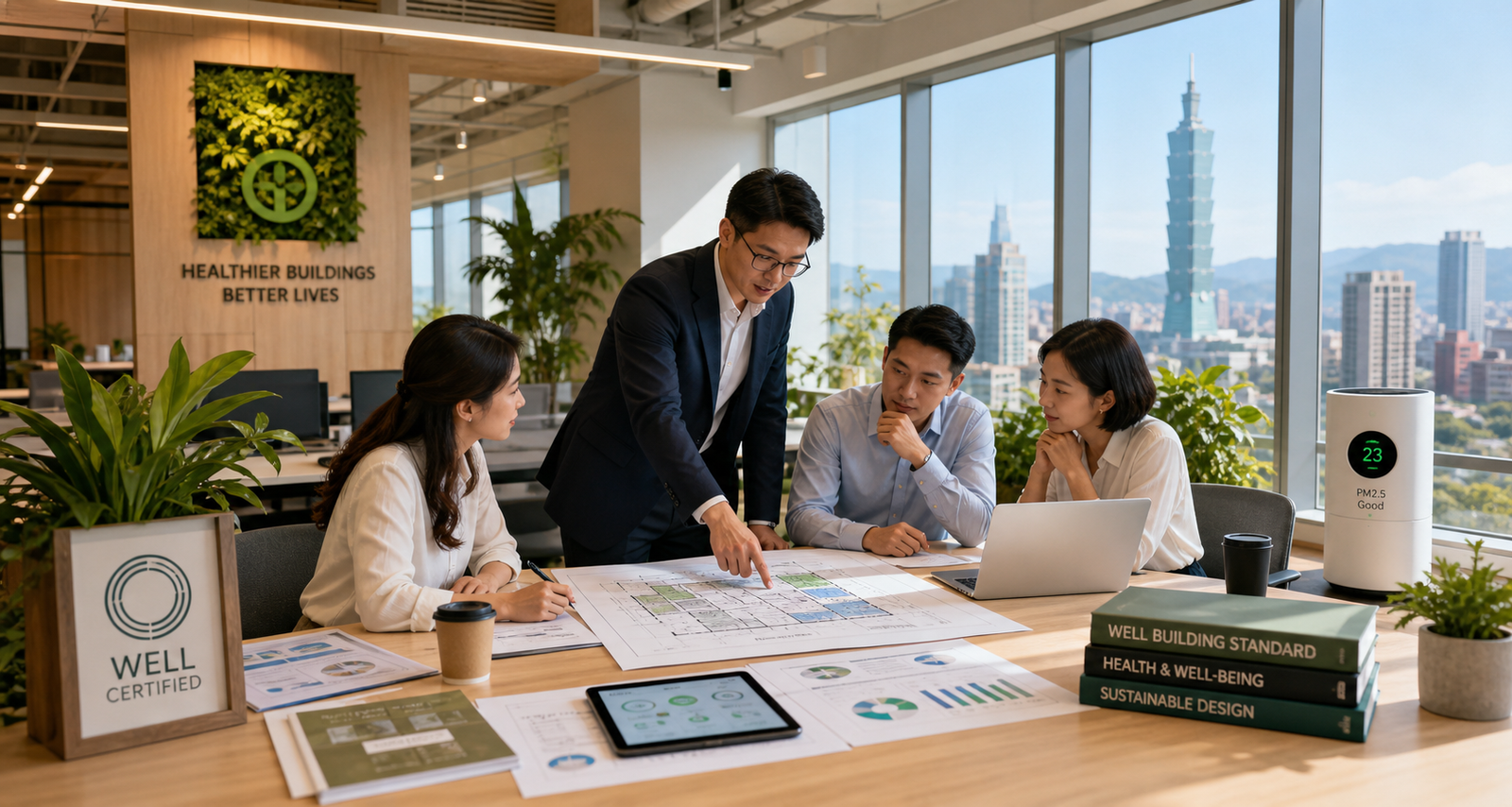
A WELL Consultant Taiwan team guides the project through technical, documentation, and coordination tasks. The consultant does not only prepare forms. A strong consultant builds a certification strategy from the first concept meeting.
The consultant usually supports five areas: target setting, design coordination, evidence planning, testing preparation, and operational policies. This work reduces late-stage conflict and keeps the team focused on verified outcomes.
A consultant also translates WELL requirements into practical design choices. The team may review ventilation, filtration, VOC controls, glare risk, acoustic privacy, drinking water, and cleaning policies.
What Is WELL Certification?
WELL certification is a healthy building certification program managed by the International WELL Building Institute. IWBI describes WELL as a standard with evidence-based design, policy, and operational strategies that improve health and well-being. Explore the official WELL certification page.
Projects can pursue certification levels such as Bronze, Silver, Gold, or Platinum. The level depends on achieved points and verified performance. A WELL consultant helps the team select achievable features and prove compliance.
WELL Consultant Taiwan Roadmap for Project Teams
A clear roadmap saves time. It also keeps the team focused when design pressure rises.
1. WELL Consultant Taiwan Project Brief
Every project should define why it wants WELL. Some owners want tenant differentiation. Others need ESG value, employee retention, or better indoor environmental quality.
The brief should include target users, project type, schedule, budget, and existing design limits. A consultant can then match WELL concepts with real needs.
2. Build a practical WELL scorecard
A scorecard shows which features the project will target. It should include a point buffer. This helps the team protect the target level if one feature becomes difficult.
In Taiwan, teams should consider humidity, cooling loads, urban noise, dense workplaces, and local material availability. These factors can affect feature selection.
3. Coordinate design before procurement
Late changes cost more. Early coordination helps the project choose better products, systems, and policies.
The WELL consultant should work with engineers, interior designers, facility managers, and procurement teams. This creates a shared plan for air, water, light, comfort, materials, cleaning, and communication.
4. Prepare evidence while the project moves
WELL documentation requires steady tracking. Teams often lose time when they collect evidence after construction.
A consultant should create a live evidence list. This can include drawings, specifications, product data, test reports, narratives, policies, and photographs.
5. Plan performance verification early
Performance verification can affect the final schedule. Air, water, sound, lighting, and thermal comfort checks need coordination.
The team should prepare spaces before testing and confirm equipment operation, cleaning status, and occupancy assumptions.
Key WELL Topics for Taiwan Projects
WELL covers many subjects. Strong projects connect them to user experience and operational control.
Indoor air quality
Good air quality starts with source control. Teams should reduce pollutants, choose low-emitting materials, and design effective ventilation. In humid climates, they should also manage moisture and mold risk.
Water quality and hydration
WELL encourages safe, accessible drinking water. Within offices and campuses, this can support daily wellness and reduce bottled water use.
Light, comfort, and acoustics
Lighting affects comfort, focus, and sleep patterns. Taiwan projects should balance daylight, glare control, visual comfort, and efficient lighting design. People also notice temperature and sound every day, so HVAC zoning and acoustic privacy need early attention.
How ERKE Supports WELL Certification in Taiwan
ERKE helps project teams turn sustainability goals into measurable actions. Our green building experts can connect WELL targets with energy performance, material strategy, indoor environmental quality, and documentation planning. You can review ERKE’s wider green building consultancy services for related support.
For Taiwan projects, ERKE can assist during concept, design, construction, and operation. This integrated approach helps owners avoid fragmented decisions. It also gives architects, engineers, and facility teams a shared certification roadmap.
A WELL consultant in Taiwan should understand international certification culture. ERKE brings that perspective to commercial, hospitality, healthcare, education, mixed-use, and industrial workplace projects.
Common Mistakes to Avoid
Many WELL projects face the same problems. First, avoid starting too late. WELL affects design, products, policies, and testing.
Second, do not treat documentation as a final task. Evidence should grow with the project.
Third, avoid choosing features only because they look easy. Some features may clash with budget, schedule, or local supply chains.
Finally, do not forget operations. WELL rewards buildings that work well after people move in.
Conclusion
WELL Consultant Taiwan support gives owners a structured path to healthier buildings. It also helps teams connect design quality with measurable occupant benefits.
A successful WELL project starts early, uses a realistic scorecard, and tracks evidence at every stage. With the right consultant, Taiwan project teams can reduce certification risk and build spaces that support comfort, trust, and value.
Frequently Asked Questions
What does a WELL consultant do in Taiwan?
A WELL consultant in Taiwan plans the certification strategy, reviews design decisions, coordinates documentation, and prepares the team for performance verification. The consultant also helps align WELL features with project goals, budget, and schedule.
Which buildings can pursue WELL certification in Taiwan?
Offices, hotels, residential projects, schools, healthcare spaces, retail areas, laboratories, and mixed-use buildings can explore WELL certification. The best pathway depends on project scope, occupancy, and operational control.
When should we hire a WELL consultant?
Hire a WELL consultant during concept or early design. Early support gives the team more options for air quality, lighting, materials, water systems, acoustics, and policies.
Can WELL work with LEED or other green building goals?
Yes. WELL can complement green building goals because it focuses on people, health, and building operations. Many teams coordinate WELL with energy, materials, and indoor environmental quality strategies.
Start Your WELL Project in Taiwan
Planning a healthy building project in Taiwan? Work with ERKE to define your scorecard, manage documentation, and prepare for performance verification. Contact our team through the ERKE contact page to discuss WELL Certificate Consultant in Taiwan services.