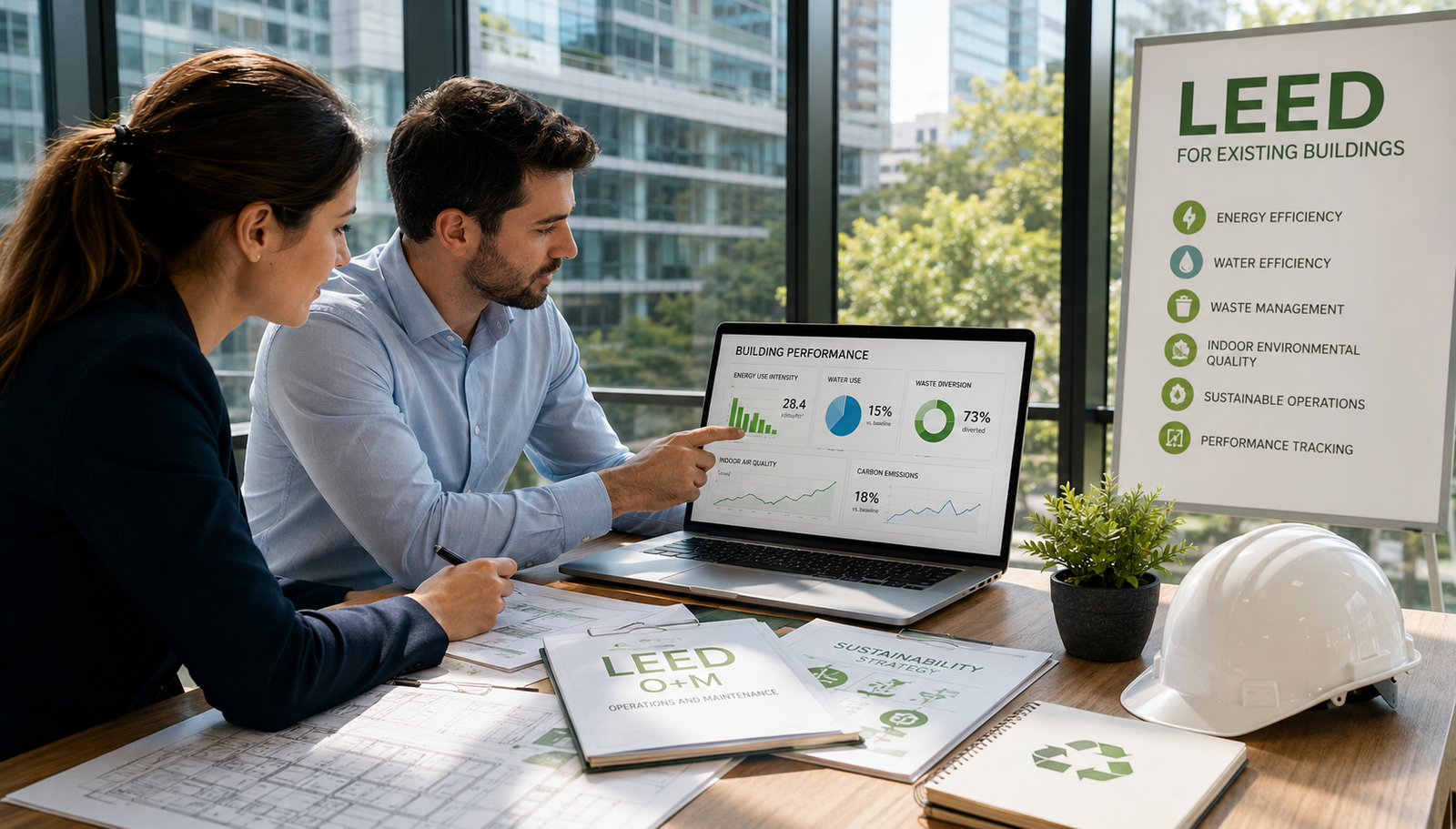
LEED Consultant Existing Buildings support helps owners turn daily operations into measurable sustainability performance. A LEED Consultant Existing Buildings strategy also gives facility teams a clear path for energy, water, waste, comfort, and documentation goals.
Existing assets carry a major opportunity. Offices, hotels, campuses, hospitals, retail buildings, and mixed-use properties already have the structure in place. The next step is smarter operation. Instead of treating certification as a one-time label, owners can use LEED as a management system. It helps teams track real performance, reduce waste, and improve indoor quality.
For global investors, tenants, and asset managers, this matters. A building that performs well can lower operating costs, support ESG targets, and strengthen market value. Yet the process requires technical clarity. Data must match the rating system. Policies must guide daily work. Documentation must tell a clear performance story.
Why a LEED Consultant for Existing Buildings Matters
LEED for existing buildings focuses on how a property performs in use. It covers energy efficiency, water use, waste streams, transportation, purchasing, green cleaning, indoor air quality, and occupant experience. The right consultant connects these areas into one practical roadmap.
A consultant helps the owner answer direct questions:
- Which rating system fits the building?
- What data do we need first?
- Which credits create the highest value?
- How can our team close performance gaps?
- What should we document for review?
This guidance saves time. It also reduces the risk of missed prerequisites, inconsistent utility data, or weak policies.
Learn more about ERKE’s LEED Consulting approach for certification planning, technical coordination, and documentation support.
What Is LEED for Existing Buildings?
LEED for Operations and Maintenance, often called LEED O+M, supports buildings that already operate. USGBC explains that this pathway fits existing buildings and spaces that have been fully operational and occupied for at least one year. You can review the official overview on USGBC’s LEED for existing buildings.
This distinction matters. New construction projects focus on design and construction choices. Existing building projects focus on measured performance and operational improvement. The building team must understand how the property uses energy, water, materials, and maintenance resources today.
A strong LEED Consultant Existing Buildings plan starts with a baseline. The team reviews utility bills, meters, equipment schedules, occupant patterns, cleaning procedures, procurement rules, and waste practices. Then the consultant builds a scorecard that reflects real opportunities, not generic assumptions.
LEED Consultant Existing Buildings: Core Responsibilities
A consultant does more than prepare forms. The role combines strategy, engineering insight, operational review, and project management.
Core responsibilities include:
- Rating system selection and eligibility review
- Gap analysis for prerequisites and credits
- Energy and water benchmarking
- Waste audit planning and diversion tracking
- Indoor environmental quality review
- Green cleaning and purchasing policy support
- Documentation management for certification review
- Coordination with facility managers and service providers
This work creates a bridge between sustainability targets and daily building operations. It also helps teams prioritize actions with clear business value.
The Business Benefits of Certification Support
Owners often ask a simple question: “Will this effort improve our building?” The answer depends on current performance, lease structure, tenant expectations, and asset strategy. Still, LEED guidance can support several business outcomes.
First, benchmarking reveals hidden inefficiencies. A building may waste energy through schedule drift, simultaneous heating and cooling, poor sensor calibration, or aging lighting controls. These issues often stay invisible until someone studies the data.
Second, certification creates a credible framework for ESG reporting. Investors want traceable evidence, not broad claims. LEED documentation helps teams show progress with structured metrics and recognized criteria.
Third, the process improves cooperation. Facility teams, property managers, procurement teams, cleaning contractors, and tenants need shared rules. A consultant turns separate activities into one coordinated program.
Finally, green building performance can support tenant satisfaction. Better air quality, thermal comfort, lighting quality, and maintenance routines help people feel confident in the space.
How the Process Works
A clear process keeps the project efficient. For most existing buildings, the work follows five stages.
1. Discovery and Data Collection
The consultant starts with the building profile. This includes size, use type, occupancy, operating hours, systems, meters, and service contracts. The team also gathers energy, water, waste, and purchasing records.
2. Performance Benchmarking
Benchmarking gives the owner a measurable starting point. ENERGY STAR Portfolio Manager helps teams measure and track energy, water, waste, and greenhouse gas emissions in a secure platform. Explore the tool through ENERGY STAR Portfolio Manager.
3. Gap Analysis and Scorecard Planning
The consultant compares current operations with LEED requirements. This step identifies easy wins, critical gaps, and actions that need more time. The scorecard should reflect budget, schedule, building type, and owner priorities.
4. Implementation Support
Next, the team improves policies, procedures, and performance. Actions may include metering updates, HVAC optimization, waste tracking, green cleaning training, purchasing rules, or indoor air quality testing.
5. Documentation and Review
Certification depends on clear evidence. The consultant organizes reports, calculations, policies, photographs, narratives, and platform entries. A quality check before submission helps prevent delays.
Key Areas a Consultant Reviews
Every building has different needs. Yet most LEED O+M projects require attention in several core areas.
Energy performance: The team studies consumption patterns, equipment schedules, controls, commissioning needs, and operational carbon.
Water efficiency: The review may include fixture performance, cooling tower practices, irrigation demand, leak detection, and water metering.
Waste management: A consultant helps define waste streams, diversion methods, tenant communication, and tracking routines.
Indoor environmental quality: This area includes ventilation, filtration, occupant comfort, air quality, lighting, acoustics, and cleaning practices.
Materials and purchasing: Sustainable procurement can cover cleaning products, consumables, facility materials, and maintenance supplies.
Conclusion
Existing buildings shape the future of sustainable real estate. They already stand in our cities, portfolios, and communities. Better operation can reduce resource use, improve occupant experience, and support credible sustainability reporting.
LEED Consultant Existing Buildings support gives owners a structured way to improve performance and pursue certification with confidence. It turns scattered data into decisions. This also turns daily operations into a clear sustainability story.
Frequently Asked Questions
What does a LEED consultant for existing buildings do?
A LEED consultant for existing buildings guides eligibility, benchmarking, gap analysis, operational improvements, and certification documentation. The consultant also coordinates facility teams, policies, and evidence for review.
Is LEED O+M only for office buildings?
No. LEED O+M can apply to many existing property types, including offices, schools, hospitality assets, retail buildings, data centers, warehouses, and mixed-use properties. Eligibility depends on the project scope and rating system.
How long does LEED certification for an existing building take?
The timeline depends on data quality, building performance, team readiness, and improvement needs. Many projects move faster when utility data, waste records, and operating policies already exist.
Do existing buildings need major renovation for LEED?
No. Existing buildings can pursue LEED O+M with little or no construction. The focus sits on operations, maintenance, measured performance, and continuous improvement.
Ready to improve your asset’s performance? Contact ERKE through the Contact Us page to discuss LEED Consultant for Existing Buildings services for your property or portfolio.