
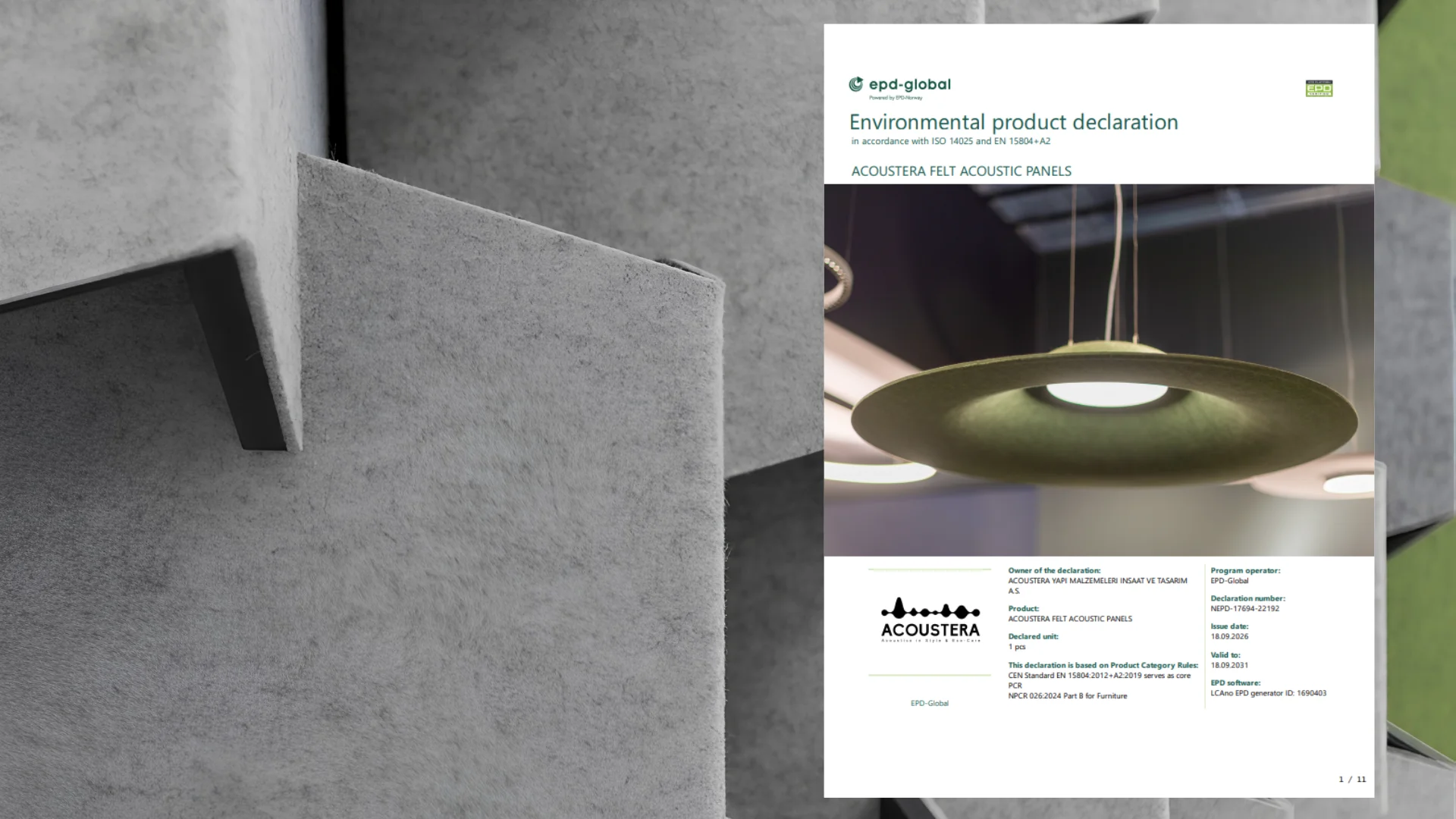
An Acoustic Panel EPD gives manufacturers and project teams a standardized way to communicate life-cycle environmental data for acoustic products. For Acoustera, ERKE developed the LCA and EPD documentation behind separate declarations for the Felt and Pluffy Felt acoustic panel ranges.
ACOUSTERA YAPI MALZEMELERI INSAAT VE TASARIM A.S. published both declarations under the EPD-Global programme. The Felt panel carries declaration number NEPD-17694-22192. Its Pluffy Felt counterpart carries NEPD-17692-22195. Both EPDs were issued on 18 September 2026 and remain valid until 18 September 2031.
The declarations follow ISO 14025, EN 15804:2012+A2:2019, and NPCR 026:2024 Part B for Furniture. Each declaration uses a declared unit of 1 piece. Production takes place at Kültür Mahallesi Öz Sokak Öz Ishani No:1 D, 81010 Merkez, Düzce, Türkiye. The stated market scope is global.
Acoustic Panel EPD Project Overview
The two EPDs cover distinct Acoustera products while using the same core methodological framework.
| Project Item | Acoustera Felt | Acoustera Pluffy Felt |
|---|---|---|
| EPD owner | ACOUSTERA YAPI MALZEMELERI INSAAT VE TASARIM A.S. | Same |
| Programme | EPD-Global | EPD-Global |
| Programme operator | EPD-Global | EPD-Global |
| Declaration number | NEPD-17694-22192 | NEPD-17692-22195 |
| Issue date | 18 September 2026 | 18 September 2026 |
| Valid until | 18 September 2031 | 18 September 2031 |
| Declared unit | 1 pcs | 1 pcs |
| Production location | Düzce, Türkiye | Düzce, Türkiye |
| Market scope | Global | Global |
Official programme pages provide the published declarations for Acoustera Felt Acoustic Panels and Acoustera Pluffy Felt Acoustic Panels.
What Does an Environmental Product Declaration Show?
An EPD is a standardized technical declaration based on life cycle assessment. It reports measurable environmental indicators under defined rules, units, modules, and scenarios.
An EPD does not function as a sustainability score. It also does not automatically prove that one product performs better than another. Instead, it creates a transparent data framework for manufacturers, designers, procurement teams, and sustainability professionals.
For manufacturers planning similar studies, ERKE’s EPD Environmental Product Declaration consultancy covers scope definition, LCA modelling, documentation, verification coordination, and publication support.
Product Scope and Acoustic Applications
Acoustera defines both products as modular acoustic panels made from 100% polyester industrial PET felt. Their intended applications include offices, educational buildings, and public spaces where teams need noise management.
The reference Felt Acoustic Panel has a thickness of 12 mm. Pluffy Felt uses a reference thickness of 15 mm. According to the declarations, both products have an NRC value of 1.0.
The declarations also report a B-s1, d0 reaction-to-fire classification and Class A according to ASTM E84. A 15-year reference service life is stated under NPCR 026:2024 for Furniture.
How the Acoustic Panel EPD System Boundary Was Defined
ERKE structured each LCA around the declared unit of 1 piece. The system boundary follows a cradle-to-gate with options approach.
Declared modules include A1-A3, A4, A5, C1-C4, and Module D. Modules B1-B7 are not declared.
The study year is 2026. Manufacturer-specific product composition data formed the foreground inventory. Background information included registered EPD data under EN 15804, Østfold Research resources, ecoinvent, and other LCA databases.
ERKE used LCA.no EPD Generator v2025.09. Generator ID 1690403 applies to Felt, while 1690405 applies to Pluffy Felt. The declarations identify Børge Heggen Johansen of Energiråd AS for company-specific input and EPD review. They identify Elisabet Amat of GREENIZE projects as third-party verifier of the EPD tool, background data, and test EPD.
Environmental Performance Results
The table below presents selected indicators within their declared modules and units.
| Indicator | Module / Unit | Felt | Pluffy Felt |
|---|---|---|---|
| GWP-total | A1-A3 / kg CO₂-eq | 12.64 | 10.66 |
| GWP-total | A4 / kg CO₂-eq | 1.17 | 1.04 |
| GWP-total | A5 / kg CO₂-eq | 0.97 | 1.53 |
| Net use of fresh water (FW) | A1-A3 / m³ | 1.03E-01 | 9.24E-02 |
| Total use of non-renewable primary energy (PENRT) | A1-A3 / MJ | 2.27E+02 | 1.98E+02 |
| Total energy consumption | D / MJ | -1.84 | -1.70 |
For both declarations, the main impact tables use a location-based approach for electricity-related greenhouse gas calculations. Therefore, these figures should be read within the stated system boundary and scenario assumptions. They should not support environmental superiority claims on their own.
Recycled Content, Chemicals, and End-of-Life Assumptions
The Felt panel contains 2.50 kg of textile felt. Of this amount, 1.50 kg, or 60.00%, is recycled content. Pluffy Felt contains 1.75 kg of felt, including 1.15 kg, or 65.81%, recycled content.
The additional environmental information reports overall recycled material shares of 55.83% for Felt and 64.04% for Pluffy Felt.
Both EPDs state that the products contain no substances included on the REACH Candidate List. VOC testing used GC-MS Headspace analysis. The tested compounds were not detected at the stated reporting limit of 2 mg/kg.
For the end-of-life scenario, the felt component is assumed to be 100% recycled in C3. The scenario assigns no disposal of that component to C4. Module D reports benefits associated with recycling through avoided production of equivalent virgin material.
ERKE’s Role in the Acoustera EPD Development
ERKE supported the project from technical scoping through EPD documentation. First, we structured the product composition, declared unit, data framework, system boundary, and scenarios. Next, we authored the LCA models for both products and organized the applicable life-cycle modules.
We then developed the EPD documentation in line with programme requirements. Finally, we coordinated the technical information needed for independent review and verification.
This approach keeps environmental communication tied to measurable evidence and defined LCA assumptions.
Why This EPD Work Matters
Product-level environmental data can support material assessment, specification, procurement, and sustainability reporting.
For acoustic products, an EPD can connect material composition, resource use, energy demand, transport, installation, and end-of-life assumptions. Product comparisons still require aligned units, PCR rules, system boundaries, methods, and scenarios.
Conclusion
The Acoustera Felt and Pluffy Felt project shows how an Acoustic Panel EPD can turn product-specific life-cycle data into transparent environmental documentation. ERKE authored the LCA and developed the EPD documentation for both products under the EPD-Global programme.
By applying ISO 14025, EN 15804:2012+A2:2019, and NPCR 026:2024 Part B for Furniture, the declarations present traceable information across the selected life-cycle modules.
For support with EPD development, LCA modelling, verification coordination, or product sustainability documentation, contact ERKE Sustainability Consultancy to discuss your product and target market.
Frequently Asked Questions
What is an Acoustic Panel EPD?
An Acoustic Panel EPD is a standardized environmental declaration based on life cycle assessment. It reports environmental indicators for an acoustic panel under defined rules, modules, units, and scenarios.
Who prepared the Acoustera Felt and Pluffy Felt EPDs?
ACOUSTERA YAPI MALZEMELERI INSAAT VE TASARIM A.S. is the EPD owner. ERKE authored the Life Cycle Assessment and developed the EPD documentation for both products.
Which standards apply to these Acoustera EPDs?
The declarations follow ISO 14025, EN 15804:2012+A2:2019, and NPCR 026:2024 Part B for Furniture.
What life-cycle stages are included?
Declared scope includes A1-A3, A4, A5, C1-C4, and Module D. Modules B1-B7 are not declared.
Does an EPD prove that an acoustic panel is environmentally superior?
No. An EPD reports standardized environmental data under defined assumptions. A valid comparison requires aligned units, boundaries, methods, PCR rules, and scenarios.