
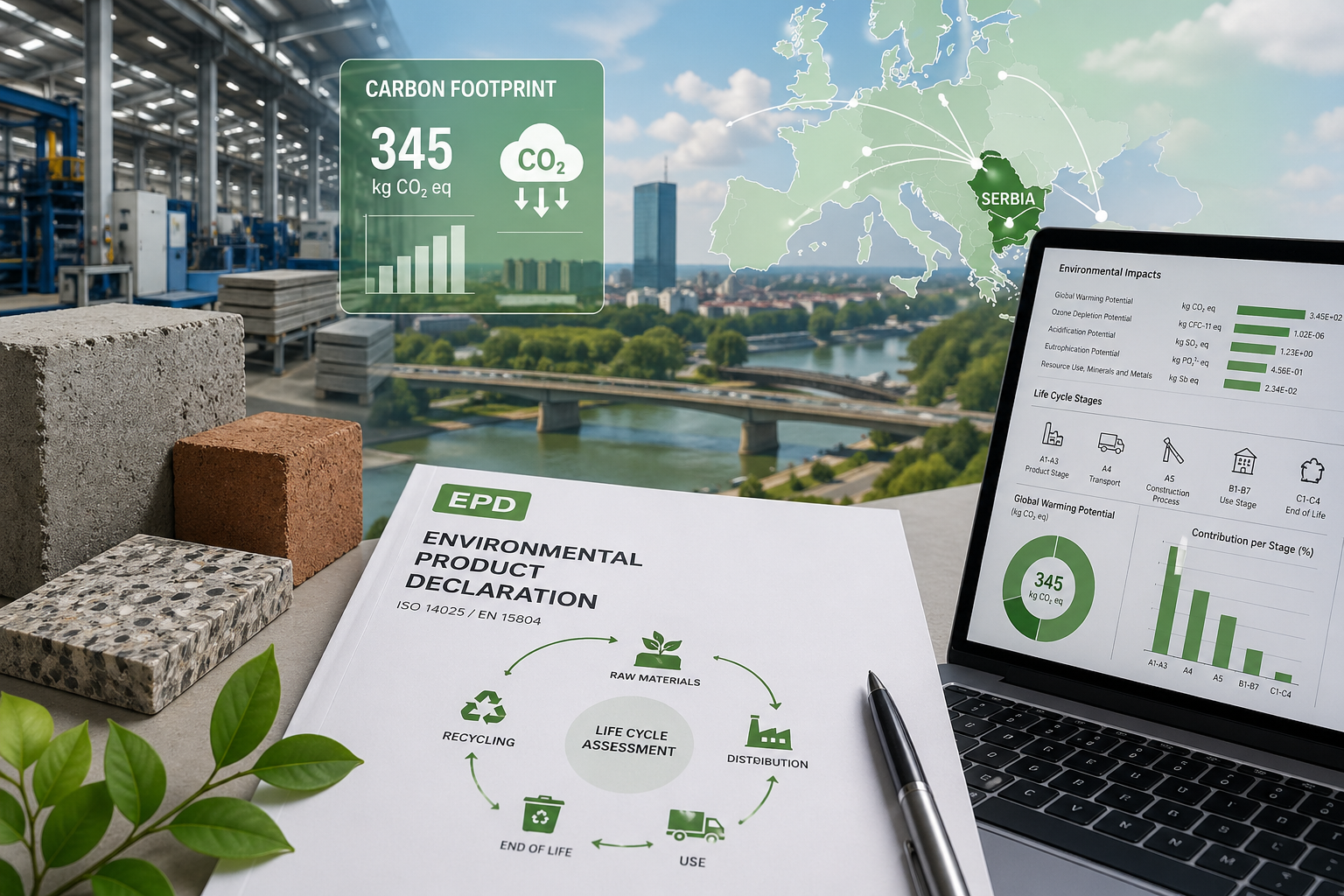
EPD Consultant in Serbia helps manufacturers prove product environmental performance with clear, verified data. For manufacturers, EPD Consultant in Serbia also supports exporters, construction suppliers, and industrial brands that need stronger access to regional and EU-linked markets.
Serbia’s manufacturing base has strong export potential. Buyers now ask sharper questions about embodied carbon, life cycle impacts, and supply chain transparency. An Environmental Product Declaration helps answer those questions with a standardized, third-party verified document.
For Serbian companies, the goal is practical. You need credible environmental data, smoother tender participation, and stronger trust with architects, contractors, developers, and international buyers.
What Does an EPD Consultant in Serbia Do?
An EPD consultant guides your team from production data to a verified Environmental Product Declaration. The process starts with a clear product scope. It then moves into data collection, life cycle modeling, impact calculation, documentation, verification support, and publication.
The International EPD System describes an EPD as a verified and registered document that communicates transparent and comparable life cycle environmental information. It also links Type III environmental declarations to ISO 14025 principles. Read the official EPD explanation from the International EPD System.
A strong consultant translates technical rules into manageable steps. Your factory team should not struggle with unclear templates or missing supplier data. Instead, the consultant creates a data request plan, reviews production flows, checks allocation logic, and aligns the study with relevant Product Category Rules.
For construction product manufacturers, EN 15804 often shapes the technical structure. Other product groups follow ISO 14025 and program operator rules. The right approach depends on your product, market, buyer requirements, and publication target.
Why Serbian Manufacturers Need Product Transparency
Serbian manufacturers connect local production with regional and European demand. Many buyers want more than price and quality. They also want proof of climate impact, resource use, waste generation, and material transparency.
This shift matters for public tenders, private developments, green building projects, and export sales. An EPD helps procurement teams compare products using a common method. It also gives design teams the data they need for whole-building life cycle assessment, green building documentation, and embodied carbon targets.
European policy pressure adds another reason to act. The European Commission provides guidance on the Carbon Border Adjustment Mechanism and related implementation resources for EU trade stakeholders. Review the European Commission CBAM guidance.
An EPD does not replace all carbon reporting. However, it strengthens your data foundation. It can also help your company respond faster when buyers ask for product carbon footprint values or verified sustainability documentation.
Key Benefits of EPD Consultant in Serbia Services
EPD Consultant in Serbia services give your product a recognized environmental passport. They can support sales, compliance, and technical communication at the same time.
First, verified data improves buyer confidence. Your claims rely on measured information, not broad marketing language. Second, your sales team can answer sustainability questionnaires faster. Many architects, developers, and multinational buyers now request product-level impact data during prequalification.
Third, EPD data supports green building projects. It can contribute to material transparency decisions in systems such as LEED, BREEAM, and other sustainability frameworks.
Finally, life cycle modeling can reveal improvement opportunities. It shows which materials, energy sources, transport routes, or packaging choices create the largest impacts.
How ERKE Supports EPD Projects in Serbia
ERKE provides an integrated path for Serbian manufacturers that want credible EPDs. Our team works across product sustainability, LCA consulting, and green building documentation. ERKE’s background includes extensive green building and sustainable material certification experience.
The project usually begins with a kick-off meeting. ERKE confirms the product family, production sites, declaration type, intended market, and preferred program operator. After that, the team prepares a data checklist for raw materials, energy, water, waste, packaging, transport, and production outputs.
Next, ERKE builds the LCA model and reviews assumptions with your technical team. This step matters because the model must reflect real production. Small errors in allocation, waste treatment, or transport distances can affect results.
After internal quality checks, ERKE prepares the EPD report package for third-party verification. The verifier may request clarifications. ERKE helps answer those comments and keeps the process moving until publication.
For detailed service information, visit ERKE’s EPD Environmental Product Declaration consultancy page. You can also explore our LCA consulting services if your team needs life cycle modeling before EPD publication.
How an EPD Consultant in Serbia Manages Data Quality
Data quality decides the credibility of the final document. A consultant should help your team collect complete, consistent, and traceable information.
Good data covers raw materials, supplier locations, production energy, fuels, water consumption, scrap rates, packaging, and logistics. It also needs a defined reference year. Most projects use one full year of production data because this creates a stable average.
The consultant should flag weak data early. For example, generic transport estimates may need confirmation. Waste disposal routes may require invoices or internal records.
What Is the EPD Process Step by Step?
A typical EPD project follows a structured sequence:
- Define the product, scope, and declared unit.
- Select the correct Product Category Rules.
- Collect manufacturing and supply chain data.
- Build the life cycle assessment model.
- Calculate impact categories.
- Prepare the EPD document and supporting report.
- Coordinate third-party verification.
- Publish the verified declaration.
Each step needs technical accuracy. Yet the process should stay understandable for factory, quality, R&D, and sales teams.
Who Should Consider an EPD in Serbia?
An EPD can benefit Serbian manufacturers that supply construction, infrastructure, interiors, packaging, and industrial product markets. It is especially useful for cement, concrete, steel, aluminum, glass, insulation, façade, flooring, furniture, paint, ceramic, and timber product suppliers.
Export-focused companies should evaluate the need early. International buyers often request product sustainability documents during supplier approval. Late action can slow tender responses.
Conclusion: Build Market Trust with Verified Product Data
EPD Consultant in Serbia services help manufacturers turn production data into credible market value. An EPD supports transparent communication, stronger procurement conversations, and better readiness for green building and export requirements.
Serbian companies do not need to wait for buyer pressure before they act. Early preparation gives your team time to improve data systems, understand product impacts, and publish a declaration with confidence.
ERKE can guide your EPD journey from the first data checklist to final publication. For support with EPD Consultant in Serbia services, contact our team through the ERKE contact page.
Frequently Asked Questions
What is an EPD Consultant in Serbia?
An EPD Consultant in Serbia helps local manufacturers create verified Environmental Product Declarations. The consultant manages data collection, LCA modeling, documentation, verification support, and publication coordination.
How long does an EPD project take?
Most EPD projects take several weeks to a few months. The timeline depends on product complexity, data readiness, supplier information, verification comments, and program operator requirements.
Which companies in Serbia need an EPD?
Construction material producers, industrial manufacturers, exporters, and suppliers for green building projects often need an EPD. Companies that sell to EU-linked supply chains can also benefit from verified product data.