
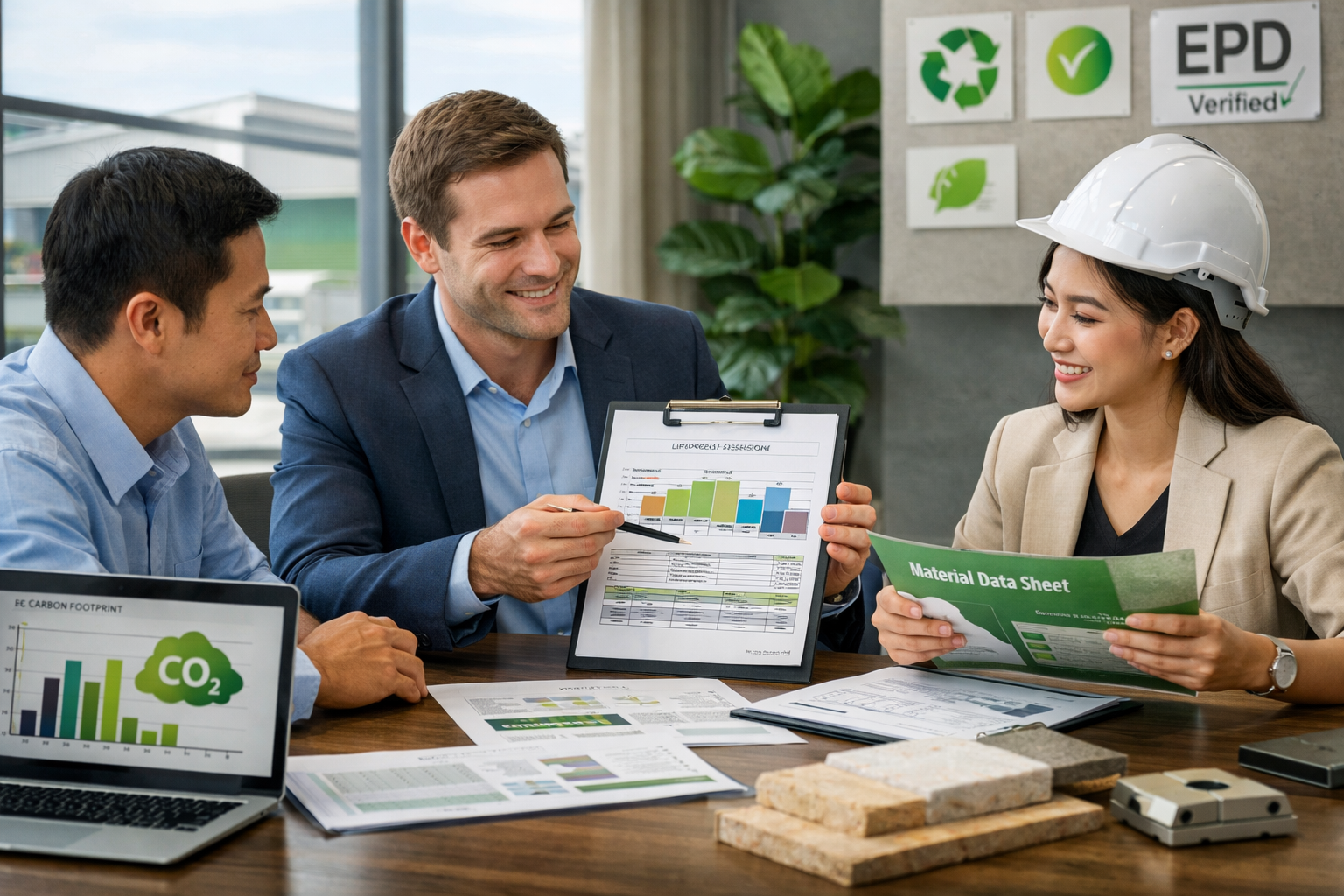
EPD Consultant Thailand services help manufacturers turn complex environmental data into a credible market asset. EPD Consultant Thailand support is especially valuable when a company wants to align product transparency with export growth, green building demand, and buyer expectations.
Across Thailand, manufacturers face growing pressure to prove environmental performance with clear, verified documents. Buyers no longer rely on broad sustainability claims alone. They want measurable data, a consistent methodology, and documentation they can compare across suppliers. That is where an Environmental Product Declaration becomes highly practical.
An EPD is a third-party verified Type III environmental declaration based on life cycle assessment methodology. It presents transparent information about a product’s environmental impact across defined life cycle stages. For manufacturers in sectors such as construction materials, insulation, finishes, metals, ceramics, and industrial components, it can strengthen both market access and technical credibility.
What Does an EPD Consultant in Thailand Actually Do?
An EPD consultant guides a manufacturer through the full process, from strategy to publication. This support matters because EPD development is technical, document-heavy, and deadline-sensitive.
A strong consultant usually helps with:
- defining the product scope and functional unit
- identifying the correct product category rules
- organizing primary and secondary data inputs
- coordinating the life cycle assessment
- preparing the EPD document for verification
- managing reviewer comments and publication steps
Without expert guidance, teams often lose time on data gaps, inconsistent assumptions, and avoidable revisions. As a result, the project becomes slower and more expensive than planned.
For companies serving green building projects, EPDs also connect with broader material transparency goals. ERKE supports this process through its EPD consultancy service and its sustainable material analysis expertise, helping manufacturers move from raw data to usable market documentation.
Why EPDs Matter for the Thai Market
Thailand has a growing sustainability focus in real estate, manufacturing, and supply chains. Green building frameworks, export requirements, and procurement standards all reward transparent environmental data. At the same time, buyers want product information they can trust and compare.
An EPD can support several business goals at once:
- stronger positioning in green building projects
- improved specification potential with architects and consultants
- clearer communication with international buyers
- better visibility in sustainable procurement processes
- a stronger internal view of carbon hotspots and resource impacts
This is especially relevant in Thailand, where green building standards continue to develop through the Thai Green Building Institute and its locally tailored frameworks. For product manufacturers that want to stay competitive, verified environmental declarations are becoming a practical differentiator rather than a niche document.
EPD Consultant Thailand: Key Benefits for Manufacturers
Choosing the right EPD Consultant Thailand partner can improve speed, data quality, and commercial value. The document itself is important, but the process behind it is equally useful.
Better Data Quality and Fewer Delays
Many EPD projects slow down because internal data is incomplete or scattered across departments. A consultant creates structure early. Procurement, production, sustainability, quality, and management teams all need to work from the same assumptions. Good coordination prevents rework.
Stronger Market Readiness
An EPD should not sit unused after publication. It should support product marketing, project submittals, technical documentation, and client communication. Therefore, the consultant should help frame the output around real business use cases.
Clear Alignment with International Standards
EPDs rely on recognized standards and programme rules. That makes them more useful for export markets and multinational project teams. Manufacturers in Thailand that sell into regional or global markets often need this level of consistency.
Insight Beyond Compliance
The process can reveal where environmental impact is concentrated. That insight can guide product redesign, sourcing decisions, packaging improvements, or energy efficiency initiatives. In other words, an EPD is not just a certificate. It can also become a decision-making tool.
How the EPD Process Usually Works
Most manufacturers benefit from understanding the process before they begin. The steps are straightforward, but each one requires careful attention.
1. Product and Scope Definition
The team defines the product, declared unit, system boundaries, and intended market use. This stage shapes the entire study, so clarity matters.
2. Data Collection and Life Cycle Assessment
Primary data from the plant is gathered. Energy use, raw materials, packaging, transport, waste, and production outputs are reviewed. Then the life cycle assessment model is built.
3. EPD Drafting and Verification
The environmental results are converted into a formal EPD document. After that, an independent verifier reviews the study and supporting documentation.
4. Registration and Publication
Once verification is complete, the EPD can be registered and published through the relevant programme operator. For many international applications, manufacturers look to recognized programmes such as The International EPD System.
How to Choose the Right EPD Consultant in Thailand
Not every consultant offers the same level of technical depth. Some can prepare documents, but few can connect product sustainability, life cycle modelling, market positioning, and green building requirements in one process.
When evaluating a consultant, look for these qualities:
- experience with LCA-based environmental documentation
- understanding of construction products and material categories
- ability to manage technical data from factories
- familiarity with verification workflows
- clear communication with both technical and non-technical teams
- practical knowledge of green building and material disclosure expectations
A consultant should also understand your target market. A company selling to local projects in Thailand may have different priorities than a manufacturer exporting to Europe or the Middle East. The best support model reflects that reality from the start.
Common Challenges Thai Manufacturers Face
Manufacturers often ask whether the hardest part is verification. In practice, the biggest challenge is usually preparation.
Typical issues include:
- missing production data
- unclear bill of materials
- inconsistent energy allocation
- supplier information gaps
- unrealistic timelines
- limited internal ownership of the process
These obstacles are manageable. However, they need a structured roadmap and an experienced lead. That is why early planning makes a major difference.
Conclusion
An EPD gives manufacturers in Thailand a credible way to present environmental performance with transparency and structure. It supports technical trust, strengthens green building relevance, and improves conversations with buyers who expect measurable sustainability data.
More importantly, the right consultant turns the EPD process into a business tool rather than a paperwork exercise. With expert guidance, manufacturers can reduce delays, improve data quality, and publish declarations that are useful in real market conditions.
Frequently Asked Questions
What is an EPD and why does it matter in Thailand?
An EPD is a third-party verified environmental declaration based on life cycle assessment data. In Thailand, it matters because manufacturers increasingly need credible product transparency for green building projects, procurement decisions, and export markets.
How long does an EPD project usually take?
The timeline depends on product complexity, data availability, and verification scheduling. In many cases, the process takes several weeks to a few months. Early data preparation can shorten the timeline significantly.
Which industries benefit most from an EPD consultant in Thailand?
Construction material producers, insulation manufacturers, metal and glass suppliers, ceramic brands, finish manufacturers, and industrial product companies often gain the most value. These sectors frequently face buyer requests for environmental data.
Can an EPD help with green building projects?
Yes. EPDs are often used to support material transparency and product selection in green building frameworks. They can improve how a product is evaluated by architects, consultants, and project teams.
Ready to Work with an EPD Consultant in Thailand?
If your company wants to develop a reliable, market-ready Environmental Product Declaration, speak with ERKE’s team through the contact page. Expert support can help you move faster, avoid costly mistakes, and build stronger product credibility in Thailand and beyond.