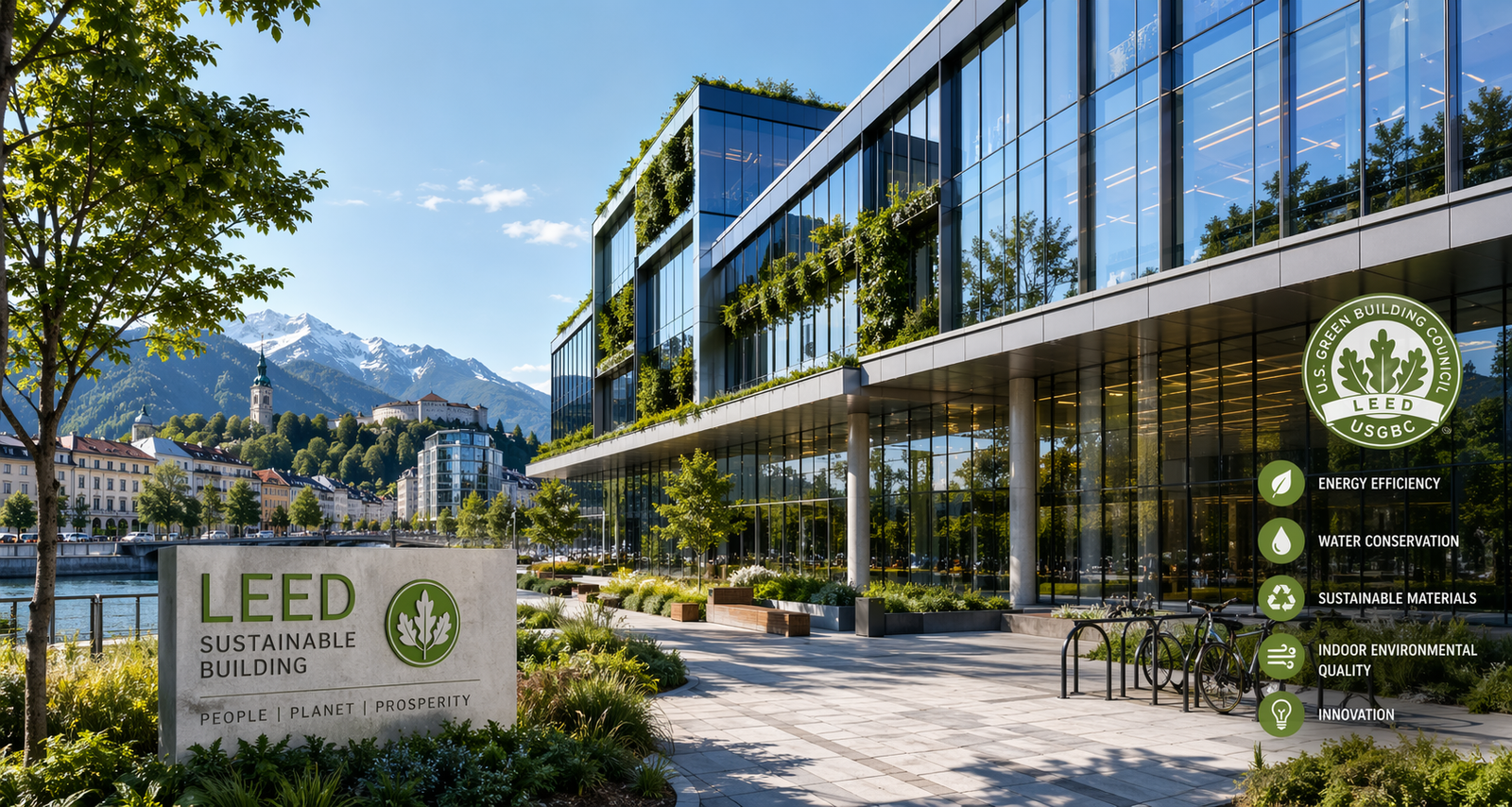
LEED Consultant in Slovenia is more than a search query. It reflects a real market need for investors, developers, architects, and occupiers who want stronger asset value, better building performance, and clearer sustainability results. A skilled LEED Consultant in Slovenia helps turn that goal into a practical certification strategy from day one.
That need is growing for a reason. The European Commission’s Energy Performance of Buildings Directive overview explains that the revised EPBD entered into force on May 28, 2024, and must be transposed into national law by May 29, 2026. At the same time, USGBC’s LEED rating system describes LEED as the most widely recognized green building rating system in the world and a framework for healthy, efficient, and cost-effective buildings.
Why a LEED Consultant in Slovenia matters now
A LEED consultant does far more than manage forms. The right advisor shapes the scorecard early, aligns the design team, reduces rework, and keeps certification goals tied to business goals throughout design and delivery. ERKE’s LEED consulting approach centers on project evaluation, certification strategy, design input, documentation, and coordination across stakeholders.
In practical terms, a consultant helps your team:
- choose the right rating path
- set a realistic certification target
- connect design decisions to credits
- manage documentation and review
- protect schedule, budget, and technical quality
This matters in Slovenia because the market is moving on several fronts at once. EU policy is pushing owners toward better energy performance and lower-emission buildings, while Green Building Council Slovenia states that its mission is to support sustainable construction, sustainable development, and real estate management. Sustainability is no longer a side issue. It is becoming part of market positioning and project quality.
What a LEED consultant actually delivers
A strong consultant starts before drawings are frozen. Early guidance often creates the biggest gains because energy strategy, material choices, water systems, indoor environmental quality, and commissioning plans affect the full project lifecycle. LEED itself applies across major project types and phases, including Building Design and Construction, Interior Design and Construction, and Operations and Maintenance.
For most projects, the work includes five core tasks.
First, the consultant defines the certification roadmap. That means selecting the right rating path and setting a target that fits the asset, budget, and timeline. Second, the consultant leads coordination. Architects, MEP engineers, sustainability specialists, contractors, and ownership teams need one shared direction. Third, the consultant supports performance-based decisions on energy, water, materials, waste, and indoor environmental quality. Fourth, the consultant manages documentation and review. Finally, the consultant helps translate certification into business value such as lower operating costs, stronger tenant appeal, and clearer ESG communication. These functions closely match the LEED consulting scope described on ERKE’s service page.
Slovenia’s opportunity: build for compliance and market value
Slovenian projects often face a double challenge. They must respond to European energy and carbon expectations while also staying attractive to lenders, international tenants, and global brands. LEED helps bridge that gap because it provides a recognized framework that speaks to both technical performance and market trust. USGBC notes that LEED is designed for all building types and phases, while the European Commission links stronger building performance to lower energy use, healthier conditions, and a more competitive construction sector.
That combination is especially valuable for office, hospitality, mixed-use, logistics, healthcare, education, and premium residential projects. In each case, a LEED strategy can support better decisions on energy use, water use, material transparency, occupant wellbeing, and long-term operations. A smart consultant keeps the process lean, focuses on credits that match the project, and builds evidence as the work progresses.
Choosing the right LEED Consultant in Slovenia
Choose a consultant with three strengths.
The first is technical depth. You need a team that understands building systems, not just paperwork. The second is international delivery experience. Slovenia sits within a broader European investment and development landscape, so many projects must satisfy both local expectations and international standards. The third is process discipline. Deadlines, workshops, contractor follow-up, and submittal quality all shape the final outcome. ERKE’s published service model emphasizes interdisciplinary guidance, project coordination, and expert support for sustainability goals.
At ERKE, this integrated approach sits at the core of our work. Our LEED Consulting and Green Building Consultancy services are built around performance-driven design, structured implementation, and expert coordination. ERKE states that it has operated since 2007, expanded into sustainability consultancy in 2009, and serves projects through offices in Istanbul, London, and Dubai. The company also presents its team as multidisciplinary, with experience across sustainability and engineering services.
Why ERKE is a strong partner for Slovenian projects
A Slovenian project does not need generic advice. It needs a partner that can connect sustainability targets with design logic, certification workflow, and commercial priorities.
ERKE brings that balance. Our consultancy model combines engineering knowledge with sustainability planning, which helps project teams make clear decisions early and avoid late-stage surprises. On its official pages, ERKE highlights interdisciplinary expertise, green building consultancy services, and a portfolio that spans multiple sectors and markets. That is the kind of structure clients need when timing, documentation, and certification quality all matter at once.
Just as important, every project has its own context. A commercial office in Ljubljana will not follow the same path as a coastal hotel or an industrial development tied to export markets. The scorecard must match the asset, the business case, and the operational model. A focused LEED strategy creates more value when it is tailored, measurable, and aligned with the people who will own, operate, and occupy the building.
Conclusion
If your project aims to compete at a higher level, working with a LEED Consultant in Slovenia can create real value. It can improve building performance, strengthen market positioning, and support a more resilient asset over time. In Slovenia, that combination is becoming more important as European building rules and investor expectations continue to rise.
The key is to start early and build a strategy that fits the project instead of forcing the project into a checklist. That is where the right consultant makes the difference.
For tailored support on certification strategy, design coordination, and documentation management, visit our Contact Us page and speak with ERKE about your next project in Slovenia.
Frequently Asked Questions
What does a LEED consultant do in Slovenia?
A LEED consultant in Slovenia guides the project team from early strategy to final submission. This usually includes rating system selection, scorecard planning, design coordination, documentation control, and support during certification review.
Is LEED relevant for projects in Slovenia?
Yes. LEED is relevant in Slovenia because it offers an internationally recognized framework for healthy, efficient, and cost-effective buildings. It also supports projects that need to align with rising expectations around energy performance, carbon reduction, and asset quality in the European market.
When should a project hire a LEED consultant?
The best time is at concept stage or early design. Early involvement helps the team set realistic targets, protect high-value credits, and reduce the risk of redesign later in the process.
Can LEED support both new and existing buildings?
Yes. USGBC states that LEED can be used for new construction, interior fit-outs, and existing building operations, depending on project scope. A consultant helps select the right path and align the team around it.