
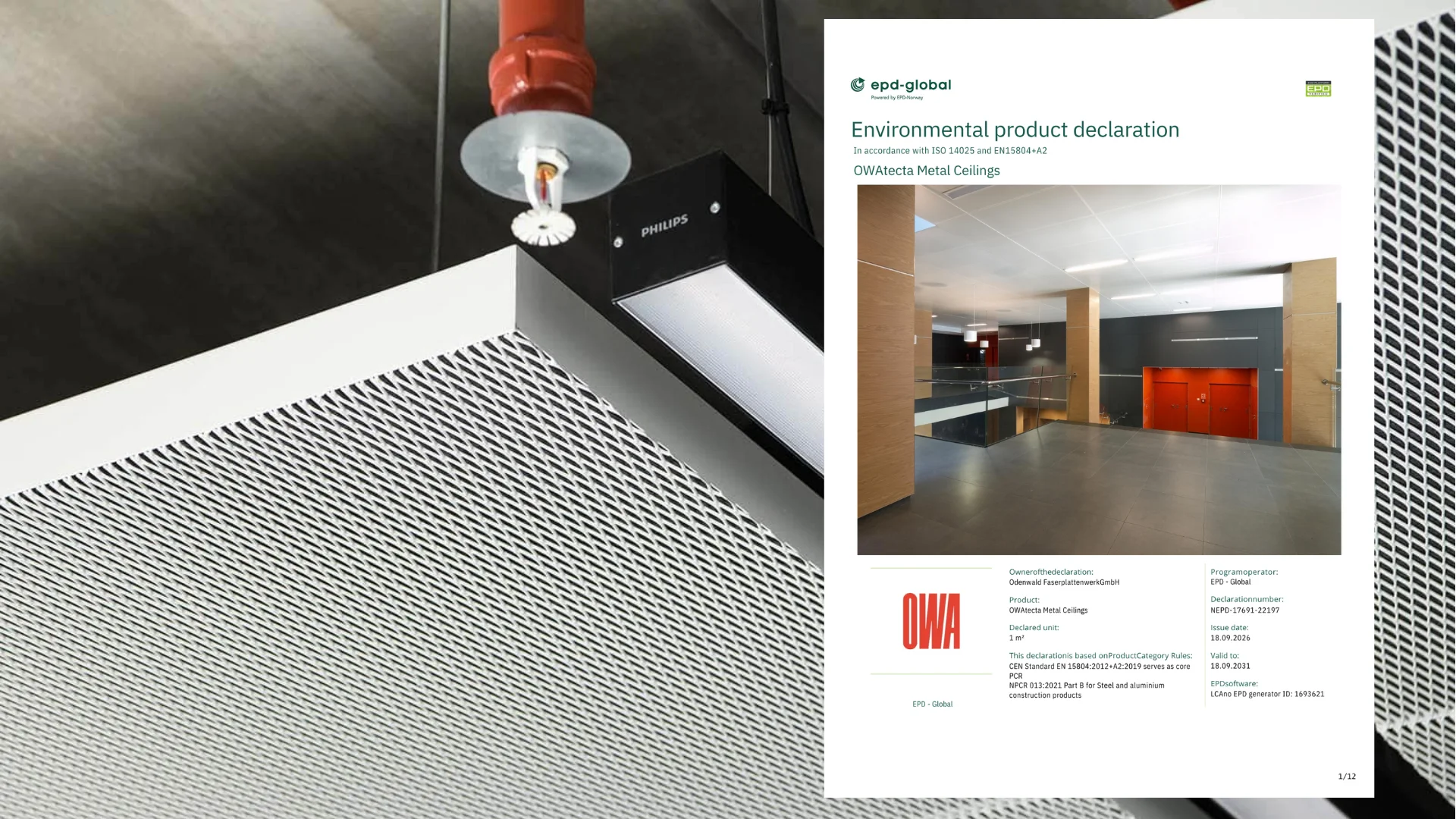
The OWAtecta Metal Ceilings EPD presents life-cycle-based environmental data for OWA’s metal ceiling product family. ERKE carried out the life cycle assessment and developed the Environmental Product Declaration. We used manufacturer-specific inputs, defined scenarios, and the declared module structure.
EPD-Global published the declaration as NEPD-17691-22197. Its issue date is 18 September 2026, and its validity ends on 18 September 2031. It uses a declared unit of 1 m² and reports impacts across production, transport, installation, end-of-life, and module D.
In brief: the declaration gives project teams a structured environmental profile of the reference product. It does not provide a sustainability score or prove environmental superiority.
Project Summary
| Item | Declaration detail |
|---|---|
| EPD owner | Odenwald Faserplattenwerk GmbH |
| Product group | OWAtecta Metal Ceilings |
| Programme | EPD-Global |
| Declaration number | NEPD-17691-22197 |
| Issue / validity | 18.09.2026 / 18.09.2031 |
| Declared unit | 1 m² OWAtecta Metal Ceilings |
| Production | Aspen Yapi ve Zemin Sistemleri San. ve Tic. A.S., Eskişehir, Türkiye |
| Declared market | Germany |
| Main standards | ISO 14025; EN 15804:2012+A2:2019 |
| Product PCR listed | NPCR 013:2021 Part B |
OWA describes OWAtecta as a metal ceiling range for architectural and functional applications, including exposed and concealed systems.
What the OWAtecta Metal Ceilings EPD Covers
An Environmental Product Declaration communicates quantified environmental information from a life cycle assessment. Defined rules govern calculation, reporting, and verification.
For this project, ERKE developed the LCA model and EPD documentation around the listed standards and PCR. These include EN 15804:2012+A2:2019, ISO 14025, and NPCR 013:2021 Part B.
An EPD is not an eco-label or product ranking. Through our EPD consultancy services, we help manufacturers structure data, model environmental impacts, prepare documentation, and coordinate the declaration process.
Product Composition and Application Context
The reference product combines galvanized steel, powder coating, and acoustic fleece. OWAtecta systems include lay-in, clip-in, hook-on, and plank solutions for different suspension concepts.
The declaration identifies EN 13964:2014 and sound absorption coefficients from αw 0.10 to 0.80. It also states a 60-year reference service life. Applications include offices, healthcare, education, retail, hospitality, laboratories, and industry.
For the reference product, the model uses 3.4 kg of powder-coated steel tile with acoustic fleece per m². The mass rises to 3.719 kg per m² including packaging.
Declared Unit, Modules and Scenarios
The declared unit is 1 m² of OWAtecta Metal Ceilings. The module matrix includes:
- A1–A3: raw material supply, transport, and manufacturing;
- A4: transport to the construction site;
- A5: installation;
- C1–C4: end-of-life stages;
- D: benefits and loads beyond the system boundary.
The declaration marks modules B1–B7 as MND, meaning “module not declared.” Its transport scenario uses 200 km in A4 and 85 km in C2.
An A1–A3 result does not represent a whole-life footprint. The remaining stages require an equivalent basis for that interpretation.
How to Read the OWAtecta Metal Ceilings EPD Results
The selected indicators below refer to 1 m² of the reference product.
| Indicator | Module | Result |
|---|---|---|
| GWP-total | A1–A3 | 8.41E+00 kg CO₂-eq |
| GWP-IOBC | A1–A3 | 8.88E+00 kg CO₂-eq |
| Net freshwater use, FW | A1–A3 | 1.19E-01 m³ |
| Total non-renewable primary energy, PENRT | A1–A3 | 9.97E+01 MJ |
| GWP-total | D | -1.87E+00 kg CO₂-eq |
The two climate indicators use different biogenic-carbon accounting conventions and are not interchangeable.
Module D reports scenario-dependent potential beyond the product system boundary. Therefore, we keep its -1.87 kg CO₂-eq result separate from A1–A3. We do not subtract it to create a simplified “net footprint.”
Data Sources and Verification Responsibilities
The study uses manufacturer-specific composition data for the 2025 study period. ERKE applied the EPD generator v2025.09, developed by LCA.no. The model uses background datasets from ecoinvent 3.10.1 and 3.6. Main results use location-based energy accounting.
Børge Heggen Johansen of Energiråd AS reviewed company-specific inputs and the EPD. Alexander Borg of Asplan Viak AS independently verified the EPD tool.
ERKE authored the LCA and developed the declaration documentation, led by EPD developer Eren Yaman. This separation keeps authorship and verification roles clear.
Material Efficiency and End-of-Life Interpretation
The model includes 0.29 kg of cardboard and 0.029 kg of wood packaging. At the factory gate, the product contains 0.00E+00 kg C of biogenic carbon. Packaging contains 1.34E-01 kg C.
A1–A3 also reports 1.57 kg of secondary material use. This inventory indicator should not be converted into a recycled-content percentage without supporting calculation rules and product data.
The declaration contains different end-of-life descriptions. One narrative uses 95% steel collection for recycling and 5% landfill. The module D text refers to 90% recovered steel. A C3 process table also describes 3.23 kg of scrap steel as “for incineration.”
We retain these statements separately instead of merging them into one recycling claim. They describe modelling assumptions and scenarios, not measured future outcomes.
Why EPD Data Matters for Product Decisions
EPDs connect a defined product, declared unit, system boundary, and environmental indicators. This structure helps teams interpret results before design or procurement decisions.
EPD data can support embodied carbon studies, material assessments, and green building documentation. However, comparisons require equivalent scope, compatible rules, and consistent units. Our LCA consulting services help manufacturers connect primary data with traceable environmental modelling.
ERKE’s Role
ERKE supported data structuring, LCA modelling, EPD development, and verification coordination. We combined manufacturer-specific inputs with background datasets and declared scenarios while keeping independent review responsibilities distinct.
Conclusion
The OWAtecta Metal Ceilings EPD translates product and manufacturing data into a structured environmental declaration. Its reference unit is 1 m² of metal ceiling product.
It reports declared modules, resource indicators, climate impacts, packaging data, and end-of-life scenarios. It does not collapse them into a single sustainability score.
For project teams, the main value lies in traceability. The declaration shows what was assessed, which rules applied, and how to interpret results.
Frequently Asked Questions
What is the declared unit for the OWAtecta Metal Ceilings EPD?
The declared unit is 1 m² of OWAtecta Metal Ceilings. Environmental indicators are reported against this reference unit.
Which life-cycle modules are included?
The declaration includes A1–A3, A4, A5, C1–C4, and D. Modules B1–B7 are marked as not declared.
What is the A1–A3 global warming potential?
The GWP-total for A1–A3 is 8.41E+00 kg CO₂-eq per m² for the reference product.
Can module D be subtracted from A1–A3?
Not as a simple net product footprint. Module D reports scenario-dependent potential beyond the product system boundary and should remain separately reported.
Does an EPD prove that a product is environmentally superior?
No. An EPD communicates environmental information using defined methods and boundaries. Product comparisons require equivalent rules, units, scopes, and building-context assumptions.
Discuss Your EPD or LCA Project with ERKE
Planning an Environmental Product Declaration, product LCA, or sustainable material assessment? Contact ERKE Consultancy to discuss the data, modelling, verification, and publication pathway for your product.