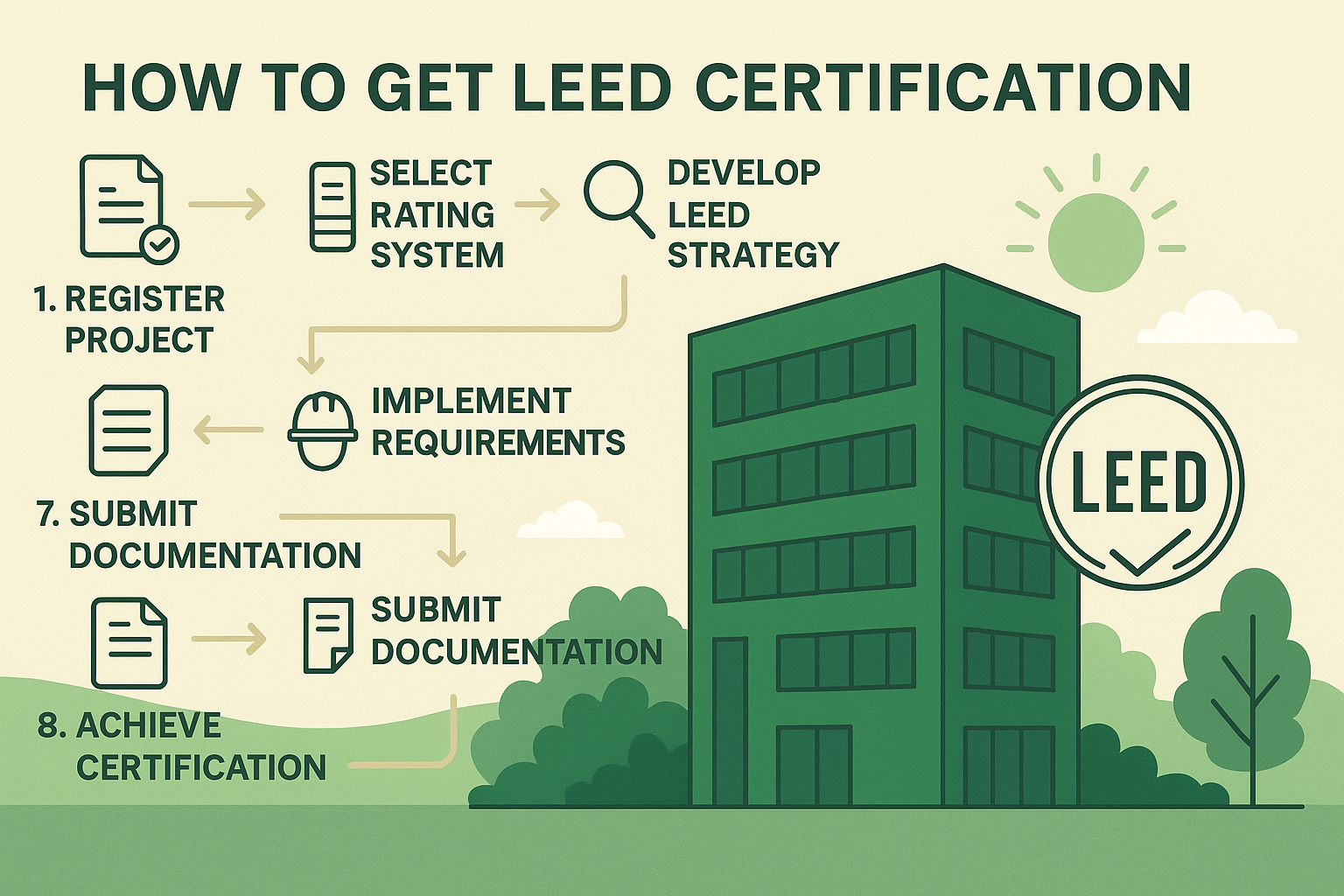
As sustainable construction gains momentum across Central Asia, developers and investors in Uzbekistan are increasingly prioritizing internationally recognized green building standards. Among these frameworks, LEED (Leadership in Energy and Environmental Design) remains the most widely adopted and trusted certification system worldwide. Yet many project owners still ask the same question: “How do we actually get LEED certification?”
This detailed guide breaks down the entire LEED certification journey into clear, actionable steps tailored specifically to the realities of Uzbekistan’s construction market. Whether you’re developing a commercial complex in Tashkent or a hospitality project in Samarkand, the following roadmap will help you understand the full process from registration to final approval.
1. Understand the LEED Rating Systems
Before applying for LEED certification, it’s essential to identify which rating system is appropriate for your project. LEED offers several pathways:
-
LEED BD+C (Building Design & Construction): For new buildings
-
LEED ID+C (Interior Design & Construction): For fit-out projects
-
LEED O+M (Operations & Maintenance): For existing buildings
-
LEED ND (Neighborhood Development): For urban-scale developments
Choosing the right category ensures compliance with credit requirements and avoids unexpected design revisions later on.
For instance, a business center in Tashkent would likely fall under LEED BD+C: Core & Shell, while a newly renovated office interior could pursue LEED ID+C: Commercial Interiors.
2. Register the Project on LEED Online
Every LEED project begins with formal registration through the LEED Online platform, operated by the U.S. Green Building Council (USGBC).
https://www.usgbc.org/leed
During registration, you will need:
-
Project details (location, size, owner, contact)
-
Selected LEED rating system
-
Registration payment
Once registered, a dedicated project portal is created for document submission and communication.
3. Conduct a LEED Feasibility Assessment
This is one of the most critical steps. A feasibility study evaluates which LEED credits your project can realistically achieve based on:
-
Building massing
-
Site constraints
-
Climate zone
-
Energy systems
-
Material availability
-
Budget
For Uzbekistan, special attention is often given to:
-
Energy modeling (due to climatic variations)
-
Material credits (availability of EPD/HPD documentation)
-
Water efficiency strategies
A strong feasibility analysis prevents mid-project redesigns and cost overruns.
For material-related credits, reliable international databases such as EPD libraries are essential:
https://www.environdec.com/
4. Develop the LEED Strategy During Design Stage
During the design phase, architects, engineers, and the LEED consultant collaborate to prepare all credit documentation. Typical design credits include:
Energy Optimization (EAc2)
Requires an energy model simulation to demonstrate reduced energy consumption.
Water Efficiency Strategies (WEc1, WEc2)
Low-flow fixtures, submetering, and water-efficient landscaping.
Heat Island Reduction & Sustainable Sites
Reflective roofs, shading strategies, parking design, and green surfaces.
Daylight & Views
Architectural modeling to enhance indoor environmental quality.
Every document must be uploaded to LEED Online for review. Good coordination at this stage significantly increases the chances of achieving a higher certification level (Gold or Platinum).
5. Implement LEED Requirements During Construction
The construction stage requires continuous monitoring to ensure LEED compliance. Key requirements include:
Construction Waste Management
Waste diversion targets typically range between 50–75%.
Low-Emitting Materials
Paints, coatings, adhesives, flooring, furniture, and ceiling systems must meet VOC limits.
Material Documentation Collection
EPDs, HPDs, FSC certificates, recycled content declarations, and product data sheets.
Indoor Air Quality Management
Filtration, dust protection, and air quality testing.
Commissioning Coordination
Early involvement of a Commissioning Authority (CxA) ensures all systems are correctly installed and functioning.
In Uzbekistan, sourcing compliant materials can be challenging; therefore, early procurement planning is highly recommended.
6. Perform Commissioning (Cx) and Quality Verification
Commissioning verifies that the building’s mechanical, electrical, and control systems operate as intended. This includes:
-
Functional performance testing
-
Review of O&M manuals
-
Training sessions for building operators
-
Monitoring-based commissioning (for higher LEED levels)
Commissioning is essential for both LEED BD+C and LEED O+M certifications and required for energy-related credits.
7. Submit Documentation to USGBC for Review
Once the design and construction documentation is complete, it is submitted to USGBC for evaluation. This process includes:
Preliminary Review
USGBC examines all credits and returns comments or requests for clarification.
Final Review
After revisions are submitted, USGBC issues the final certification decision.
Certification levels depend on total credit points achieved:
-
Certified (40–49)
-
Silver (50–59)
-
Gold (60–79)
-
Platinum (80+)
8. Achieve LEED Certification and Maintain Performance
After receiving certification, it is recommended to:
-
Maintain documentation for potential audits
-
Track energy and water performance
-
Train facilities teams on O&M practices
-
Consider LEED O+M recertification every 3 years
Sustainability is not a one-time achievement; it is an ongoing performance commitment.
Why LEED Certification Matters in Uzbekistan
LEED-certified buildings in Uzbekistan benefit from:
-
Higher investor confidence
-
Lower long-term energy and water costs
-
Improved indoor environmental quality
-
Enhanced public reputation
-
Compliance with international sustainability standards
With Uzbekistan’s rapid modernization, LEED has become a key differentiator for premium real estate developments.
How ERKE Sustainability Consultancy Supports LEED Projects
ERKE provides complete LEED management for projects in Uzbekistan, including:
-
Rating system selection
-
Energy and daylight modeling
-
LEED documentation preparation
-
Construction phase monitoring
-
Commissioning
-
Submission management
https://erkeconsultancy.com/leed-consulting/
ERKE’s experience in Central Asia ensures that local challenges—such as material documentation and climate-based energy strategies—are managed efficiently and professionally.