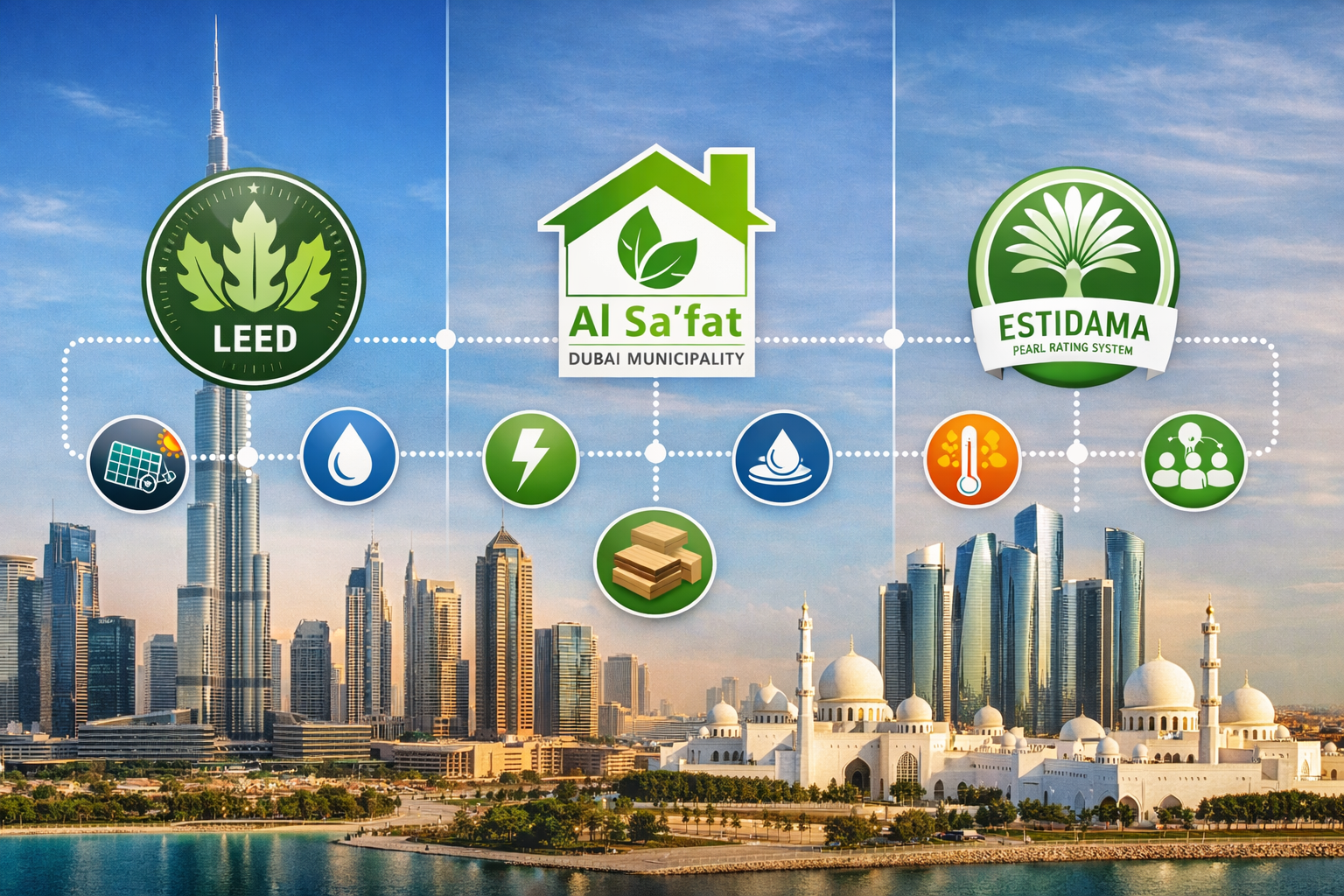
The question of LEED vs Estidama is one of the most critical strategic decisions facing developers, investors, and project managers in the UAE today. With Dubai and Abu Dhabi each operating under distinct sustainability frameworks—Al Sa’fat in Dubai and Estidama Pearl Rating System in Abu Dhabi—choosing the right certification path directly affects regulatory compliance, project value, ESG performance, and long-term operational efficiency.
For international developers, the challenge becomes even more complex: should a project pursue LEED, a globally recognized certification, or comply solely with local systems such as Estidama or Al Sa’fat? In this guide, we break down LEED vs Estidama, explain where Al Sa’fat fits in, and clarify how to select the most suitable sustainability strategy for your UAE project.
Understanding the UAE Sustainability Landscape
The UAE has positioned itself as a regional leader in sustainable development. However, sustainability is regulated differently across emirates:
-
Dubai: Al Sa’fat Green Building Rating System (Dubai Municipality)
-
Abu Dhabi: Estidama Pearl Rating System (Department of Municipalities & Transport)
-
International / Market-Driven: LEED (U.S. Green Building Council)
Understanding how LEED vs Estidama compares within this framework is essential for risk mitigation and value optimization.
What Is LEED and Why Is It Still Relevant in the UAE?
LEED (Leadership in Energy and Environmental Design) is the world’s most widely adopted green building certification, administered by the U.S. Green Building Council (USGBC). It evaluates buildings across categories such as energy efficiency, water conservation, materials, indoor environmental quality, and carbon impact.
Key Advantages of LEED in the UAE
-
Strong recognition by international investors and tenants
-
Supports ESG reporting and green finance
-
Flexible system adaptable to UAE climate conditions
-
Enhances asset value for Grade A commercial real estate
Many landmark developments in Dubai and Abu Dhabi voluntarily pursue LEED in addition to local requirements. Learn more about LEED consulting services via our internal expertise page:
👉 https://erkeconsultancy.com/leed-consulting/
For official LEED standards, refer to the U.S. Green Building Council:
👉 https://www.usgbc.org/leed
Estidama Pearl Rating System: Abu Dhabi’s Mandatory Framework
When comparing LEED vs Estidama, it’s crucial to understand that Estidama is mandatory for most Abu Dhabi projects.
Estidama, meaning “sustainability” in Arabic, is deeply rooted in the UAE’s cultural, environmental, and climatic context. The Pearl Rating System prioritizes:
-
Water scarcity management
-
Energy demand reduction in extreme heat
-
Cultural and social sustainability
-
Long-term livability
Key Characteristics of Estidama
-
Mandatory minimum 1 Pearl for private projects
-
2 Pearls or more required for government buildings
-
Strong focus on regional environmental priorities
Unlike LEED, Estidama is not optional in Abu Dhabi—it is a regulatory requirement. More information can be found via Abu Dhabi’s official Estidama program:
👉 https://erketasarim.com/en/estidama-certification
Where Does Al Sa’fat Fit in the LEED vs Estidama Debate?
Al Sa’fat is Dubai’s green building rating system, administered by Dubai Municipality. While often compared with Estidama, Al Sa’fat differs in structure and enforcement.
Al Sa’fat Key Points
-
Mandatory for all new buildings in Dubai
-
Star-based rating system
-
Strong emphasis on energy, water, and materials efficiency
-
Integrated directly into Dubai Municipality approvals
In the LEED vs Estidama discussion, Al Sa’fat acts as Dubai’s local compliance baseline—similar in intent to Estidama but less internationally recognized.
Official reference:
👉 https://www.dm.gov.ae/what-we-do/building-regulations/green-building/
LEED vs Estidama vs Al Sa’fat: Strategic Comparison
1 Choose LEED If:
-
Your project targets international investors or tenants
-
ESG reporting and green finance are priorities
-
You want global brand recognition
-
The asset may be sold or leased internationally
2 Choose Estidama If:
-
The project is located in Abu Dhabi
-
Regulatory compliance is mandatory
-
Cultural and climatic adaptation is critical
-
Government approvals are involved
3 Choose Al Sa’fat If:
-
The project is in Dubai
-
You need municipal approval
-
The focus is local compliance rather than global branding
Best-Practice Approach in the UAE
Many high-value projects pursue dual certification:
-
Estidama or Al Sa’fat for compliance
-
LEED for international credibility and ESG alignment
This integrated approach maximizes both regulatory security and market positioning.
Cost, Timeline, and Risk Considerations
When evaluating LEED vs Estidama, developers must consider more than sustainability intent.
-
Cost: LEED often involves higher documentation and consultancy costs, but yields stronger ROI.
-
Timeline: Estidama and Al Sa’fat are embedded in permitting timelines; LEED runs in parallel.
-
Risk: Incorrect certification selection can delay approvals or reduce asset attractiveness.
Expert guidance is essential to avoid duplication, inefficiencies, or missed credits.
Frequently Asked Questions (FAQ)
Is LEED mandatory in the UAE?
No. LEED is voluntary across the UAE. However, it is often pursued alongside Estidama or Al Sa’fat for added value.
Can a project achieve both LEED and Estidama?
Yes. Many Abu Dhabi projects achieve Estidama compliance + LEED certification through integrated documentation and design strategies.
Which certification is better for ESG reporting?
LEED is generally more recognized by international ESG frameworks, investors, and financial institutions.
Is Al Sa’fat equivalent to Estidama?
No. While similar in intent, Al Sa’fat applies to Dubai, Estidama applies to Abu Dhabi, and their technical requirements differ.
Final Thoughts: Making the Right Choice for Your UAE Project
The decision between LEED vs Estidama—and where Al Sa’fat fits—should never be made in isolation. It must align with your project location, investor expectations, regulatory obligations, and long-term asset strategy.
A well-planned sustainability roadmap can reduce risk, improve performance, and significantly enhance project value in the competitive UAE real estate market.
Planning a project in Dubai or Abu Dhabi and unsure whether LEED, Al Sa’fat, or Estidama is the right path?
ERKE Sustainability Consultancy provides end-to-end advisory services, from certification strategy to implementation and approval management.
👉 Contact our expert team today:
https://erkeconsultancy.com/contact-us/
Let us help you choose the most effective certification path for your UAE project—strategically, efficiently, and confidently.