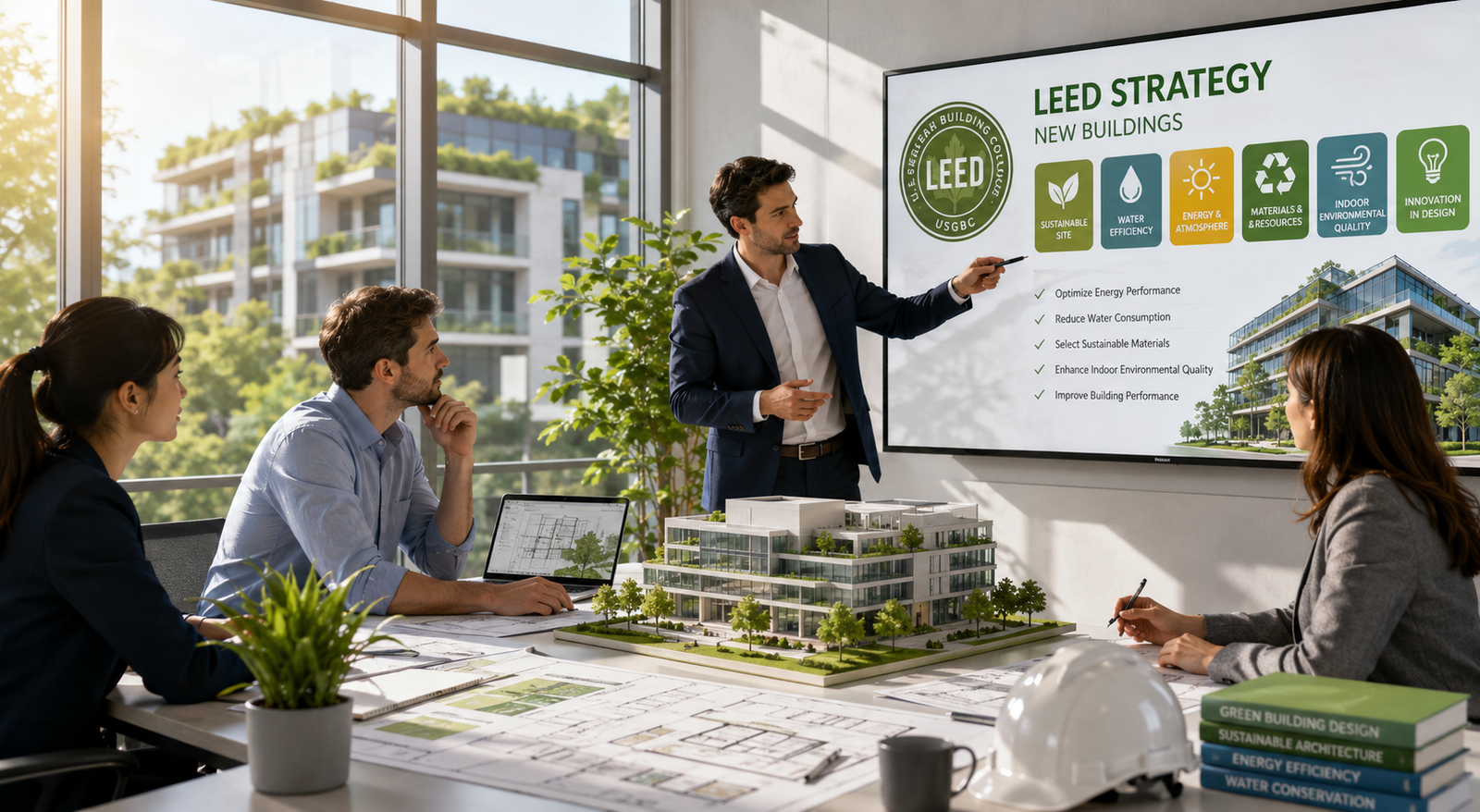
LEED Consultant New Buildings support helps project owners plan certification before design decisions become costly. LEED Consultant New Buildings guidance also helps architects, engineers, and contractors work toward one clear sustainability target.
New buildings shape long-term operating costs, indoor comfort, carbon impact, and asset value. Therefore, the certification strategy should start early. A consultant turns sustainability goals into practical actions. Also, the consultant helps the team understand which credits fit the project’s location, budget, use type, and delivery model.
For global developers, LEED offers a recognized framework for high-performance buildings. However, certification success depends on more than good intentions. The project team needs a realistic scorecard, consistent documentation, and strong coordination. ERKE supports these needs through its LEED Consulting services for international projects.
Why LEED Consultant New Buildings Support Matters
A LEED consultant for new buildings connects the rating system with real project decisions. Instead of treating certification as a late-stage paperwork task, the consultant brings it into design planning.
Early involvement can improve energy strategy, water efficiency, façade performance, site planning, material selection, and indoor environmental quality. As a result, the owner can avoid redesign, missed credits, and weak documentation. Moreover, the design team gains a shared roadmap.
Many new construction projects include complex teams. Architects, engineers, contractors, suppliers, and facility managers all affect LEED outcomes. Therefore, someone must coordinate credit intent, evidence, deadlines, and responsibilities. A consultant gives that structure.
USGBC explains that LEED rating systems support different building and project types. For new construction, teams often review the official LEED for new buildings pathway. This early selection matters because the wrong pathway can create delays.
What Does a LEED Consultant Do for New Buildings?
A consultant helps the team move from ambition to measurable performance. First, the consultant reviews the project scope, location, design stage, and owner goals. Then, the consultant recommends the rating system and prepares a preliminary scorecard.
After that, the team can decide which credits offer the best value. Some credits support lower operating costs. Others improve user experience, market position, or environmental reporting. In addition, several credits work together and should not stand alone.
Core tasks include rating system selection, feasibility review, workshops, scorecard planning, design review, contractor guidance, document tracking, and submission coordination. This role also reduces uncertainty. For example, a contractor may choose a product without proper emission data. In that case, the project could lose a material or indoor air quality credit.
LEED Consultant New Buildings Tasks by Project Phase
The consultant’s work changes during each project phase. During concept design, the focus sits on goals, rating system selection, and credit feasibility. At schematic design, the team tests energy, water, site, and material strategies. Later, design development turns those choices into drawings and specifications.
During construction, the consultant tracks submittals, site evidence, waste data, commissioning records, and product documentation. Meanwhile, the contractor receives clear instructions. This step protects the project from missing proof.
At submission stage, the consultant checks consistency. Numbers, drawings, calculations, narratives, and forms must tell the same story. Then, the team can submit with more confidence.
Core LEED Strategies for New Construction
Strong certification planning starts with a simple question: which strategies create the most value for this building? The answer changes by climate, function, site, budget, and owner priorities.
Integrative Design and Early Workshops
An early sustainability workshop helps the team agree on goals. For example, the owner may prioritize lower utility costs, tenant appeal, carbon reduction, or wellness. Once the team defines these priorities, the consultant can match them with suitable credits.
This workshop should include decision makers. Otherwise, the project may set goals that later conflict with cost, schedule, or technical limits. In addition, early collaboration reveals synergies between building systems.
Energy Performance and Carbon Planning
Energy performance often has a major effect on certification results. Therefore, teams should study passive design, insulation, glazing, HVAC efficiency, lighting systems, controls, commissioning, renewable energy, and electrification.
A strong consultant does not look at energy as one isolated topic. Instead, the consultant helps the team connect energy use with comfort, cost, carbon, and long-term operation. For further context, the Guide to LEED Certification outlines the broader certification process.
Water, Materials, and Indoor Quality
Water strategy should match the local climate. In dry regions, efficient fixtures and native planting can create strong benefits. In dense urban sites, rainwater management may reduce runoff pressure and support resilience.
Material choices influence embodied carbon, indoor air quality, circularity, and procurement risk. Therefore, teams should discuss products before the tender stage. Environmental product declarations, low-emitting materials, recycled content, and responsible sourcing can all support the strategy.
People spend many hours inside buildings. For that reason, indoor environmental quality deserves careful attention. Fresh air, daylight, views, thermal comfort, acoustic quality, and low-emitting materials can improve the daily experience of occupants.
How ERKE Adds Value to Global Project Teams
ERKE combines sustainability consulting with engineering-based coordination. This approach helps project teams turn LEED requirements into practical design and construction steps. It also supports clear communication across international stakeholders.
For owners, ERKE creates a structured certification roadmap. For architects, the team provides clear sustainability targets. Meanwhile, engineers gain credit guidance that connects technical design with documentation needs. Contractors also receive practical direction during procurement and construction.
ERKE’s wider Green Building Consultancy experience helps teams align LEED goals with broader sustainability aims. These aims may include energy efficiency, carbon reduction, water management, responsible materials, and healthier indoor spaces.
Common Mistakes to Avoid
Many projects start LEED too late. Consequently, the team may miss simple design opportunities. Early planning avoids this risk.
Another mistake involves unrealistic scorecards. A project may target credits that do not match the budget, climate, site, or program. Therefore, the consultant should test feasibility before the owner confirms the target level.
Poor documentation also creates problems. Drawings, calculations, invoices, product sheets, and narratives must match. If they do not, review comments can slow the process.
Finally, weak contractor engagement can reduce success. The construction team needs clear LEED duties before procurement begins. Otherwise, missing product data and site records can place credits at risk.
Conclusion
LEED Consultant New Buildings support gives global project teams a clear path to certification. It also helps owners make better design, construction, and procurement decisions from the start.
A new building will operate for many years. Therefore, early sustainability planning can influence costs, comfort, carbon impact, and market value. With the right consultant, LEED becomes a practical project management tool rather than a late-stage checklist.
ERKE helps developers, architects, engineers, and contractors plan certification with confidence. Through structured coordination and technical insight, the team supports new buildings that perform better for owners, occupants, and the environment.
Frequently Asked Questions
What is a LEED consultant for new buildings?
A LEED consultant for new buildings guides the project team through certification planning, design coordination, documentation, and submission. The consultant helps the team choose the right rating system, build a scorecard, and manage credit evidence.
When should we hire a LEED consultant?
Hire a LEED consultant before schematic design begins. This timing helps the team capture low-cost opportunities and avoid late design changes.
Which LEED system applies to new buildings?
Most whole-building new construction projects use a LEED Building Design and Construction pathway. However, the best option depends on project type, scope, completion level, and ownership model.
Ready to plan your next certified project? Visit ERKE’s contact page to discuss LEED Consultant New Buildings services with our expert team.