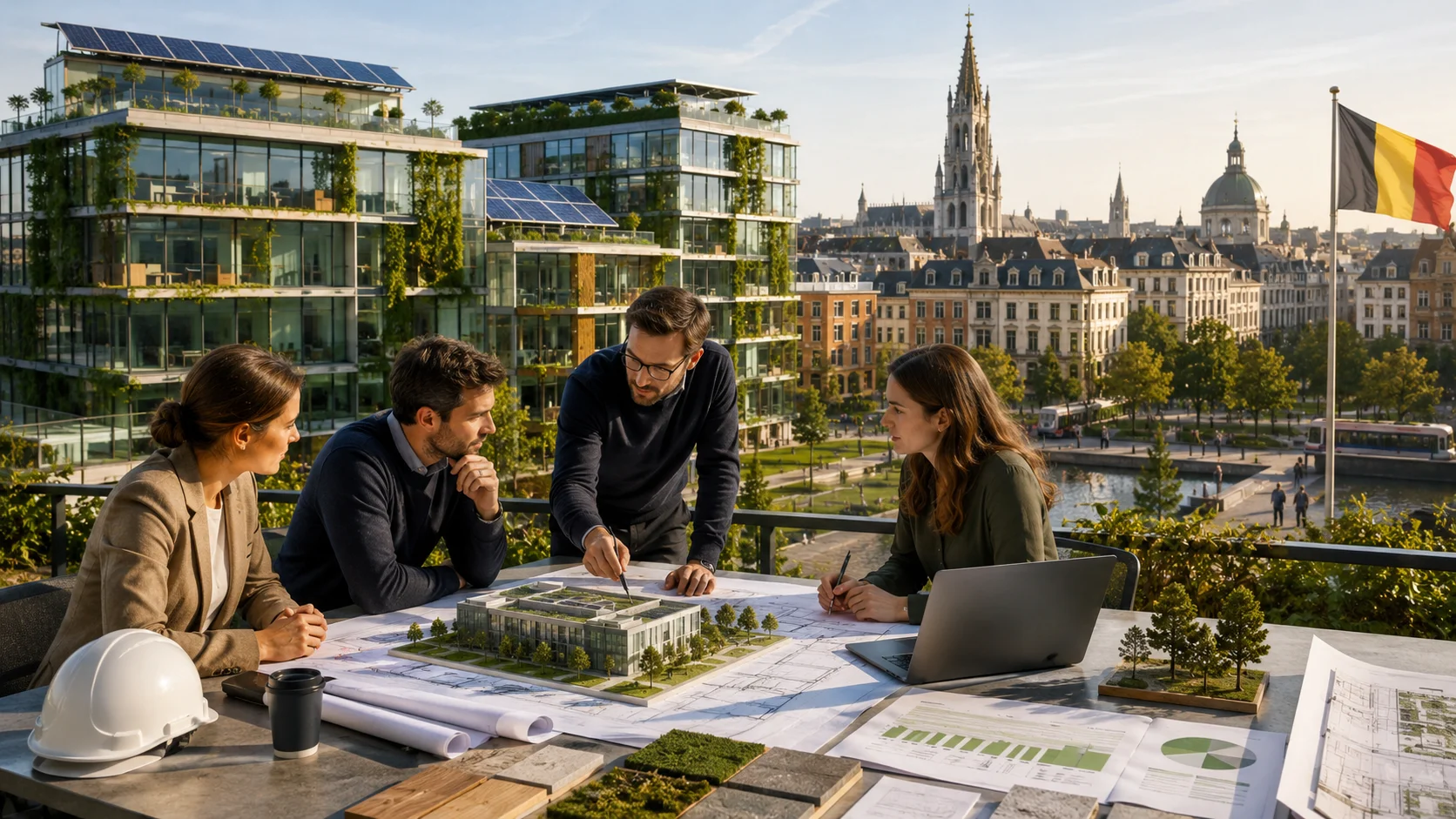
LEED Consultant in Belgium is a key search for developers who want a clear path to green building certification. A LEED Consultant in Belgium helps project teams plan credits, manage documentation, and align design choices with measurable sustainability goals.
Belgium has a demanding real estate market. Brussels, Antwerp, Ghent, Leuven, Liège, and Charleroi all host projects that must balance energy performance, investor expectations, tenant comfort, and EU climate goals. LEED gives these projects a global framework. It also helps owners communicate quality through a recognized certification level.
For investors, LEED can support asset value, ESG reporting, and long-term operational efficiency. Design teams gain a shared roadmap. Occupants benefit from healthier indoor spaces, better daylight, efficient systems, and responsible material choices.
Why a LEED Consultant in Belgium Matters
A LEED consultant turns certification targets into project actions. The role starts before concept design and continues through review. Early guidance saves time because the team can select the right rating system, define the LEED boundary, and avoid weak credits.
Belgian projects often face mixed requirements. An office in Brussels may need strong energy modeling. A logistics project near Antwerp may focus on transport access, water efficiency, and construction waste. A hotel in Bruges may need a balanced strategy for guest comfort, indoor air quality, and operational performance.
LEED also connects well with Europe’s energy agenda. The European Commission’s Energy Performance of Buildings Directive supports renovation, solar readiness, life-cycle global warming potential, and building automation. These themes match many LEED categories.
What Does LEED Certification Cover?
LEED stands for Leadership in Energy and Environmental Design. The U.S. Green Building Council describes LEED as a widely recognized green building rating system for healthy, efficient, and cost-effective buildings. Project teams earn certification by meeting prerequisites and collecting points across credit categories.
LEED can apply to new construction, core and shell developments, commercial interiors, and existing building operations. The right path depends on the project scope. A full office tower may use BD+C. A tenant fit-out may use ID+C. An existing portfolio may use O+M.
Core topics include integrative planning, public transport, site protection, water efficiency, energy performance, commissioning, refrigerants, renewable energy, EPDs, responsible sourcing, waste diversion, embodied carbon, indoor air quality, daylight, comfort, and views. LEED v5 also places strong emphasis on decarbonization, quality of life, and ecological conservation.
How ERKE Supports LEED Projects in Belgium
ERKE combines green building consulting with engineering insight. The team supports owners, developers, architects, contractors, and project managers from strategy to submission. You can explore ERKE’s dedicated LEED consulting services for a deeper view of the certification scope.
LEED Consultant in Belgium: Core Deliverables
A strong consulting scope gives the team clarity from day one. ERKE can support the process with six core actions.
First, the consultant reviews drawings, building type, site data, energy goals, and owner priorities. Then the team sets a realistic target such as Certified, Silver, Gold, or Platinum.
Next, the consultant checks whether BD+C, ID+C, O+M, or another path fits best. This step reduces registration risk.
After that, the team creates a credit responsibility matrix. Architects, MEP engineers, contractors, landscape teams, and suppliers all receive clear tasks.
During design, the consultant reviews specifications, material choices, energy assumptions, and site strategies. This keeps the scorecard aligned with decisions.
For submission, the consultant gathers forms, calculations, narratives, product data, commissioning records, photos, and construction reports. Review comments then receive fast, accurate responses.
This workflow helps teams reduce missed points. It also links sustainability goals with daily project decisions.
Belgium-Specific Priorities for LEED Strategy
Every market has its own project drivers. Belgium has four strong themes that deserve attention during LEED planning.
Energy Performance and Decarbonization
Energy efficiency usually drives the scorecard. Belgium’s climate, dense urban fabric, and EU policy context make operational carbon a key issue. Teams should focus on envelope quality, HVAC efficiency, heat recovery, commissioning, controls, and renewable energy readiness.
Energy modeling can test design options early. It can compare glazing ratios, shading, system choices, lighting power, plug loads, and heat pump scenarios. This analysis helps the owner select measures with long-term value.
Materials, EPDs, and Embodied Carbon
Belgian projects often use European supply chains. This creates a strong opportunity to request Environmental Product Declarations, low-emitting materials, recycled content, and responsible sourcing data.
Material decisions should begin during specification. Late product changes can weaken documentation. A good LEED plan gives suppliers clear requirements before procurement starts.
Mobility and Urban Location
Many Belgian sites benefit from public transport, cycling networks, and compact urban development. Brussels, Antwerp, Ghent, and Leuven can score well when teams document transit access, bicycle facilities, reduced parking, and EV infrastructure.
These credits also support tenant value. Modern companies want workplaces that reduce commuting friction and support healthier mobility habits.
Indoor Environmental Quality
Healthy interiors matter for offices, schools, hotels, and healthcare spaces. LEED encourages fresh air, low-emitting materials, daylight, glare control, thermal comfort, acoustic quality, and occupant experience.
Good indoor quality also helps leasing. Tenants increasingly ask for spaces that support well-being, productivity, and sustainability reporting.
When Should You Hire a LEED Consultant?
Hire a LEED consultant before concept design ends. Early involvement gives the project more options. The team can define the target, select the rating system, protect easy points, and avoid costly redesign.
Late involvement still helps, but it creates limits. The consultant may find missing product data, weak metering plans, or overlooked commissioning steps. Fixing these items after tender can cost more than planning them early.
For best results, invite the consultant to kickoff meetings, design workshops, value engineering reviews, and contractor onboarding sessions. LEED works best when every discipline understands its role.
Conclusion
A LEED Consultant in Belgium helps project teams turn sustainability goals into clear design, construction, and documentation actions. The right consultant improves coordination, protects certification points, and connects global LEED requirements with Belgium’s energy, carbon, mobility, and indoor quality priorities.
Belgian developers, investors, architects, and corporate owners can use LEED to create healthier, more efficient, and more marketable buildings. With early planning, smart credit selection, and disciplined documentation, certification becomes a structured business process.
Frequently Asked Questions
What does a LEED Consultant in Belgium do?
A LEED consultant guides the project team through rating system selection, scorecard planning, design reviews, documentation, submission, and review responses.
Is LEED certification useful for projects in Belgium?
Yes. LEED gives Belgium-based projects an international sustainability framework. It can support ESG goals, tenant expectations, energy planning, material transparency, and asset positioning.
Which LEED rating system should a Belgian project use?
The right rating system depends on scope. New buildings often use BD+C. Tenant interiors may use ID+C. Existing assets may use O+M.
When should we start LEED planning?
Start during pre-design or concept design. Early planning helps the team select achievable credits, align technical systems, request product data, and avoid expensive changes later.
Start Your LEED Project in Belgium with ERKE
Planning a certified office, hotel, mixed-use development, industrial facility, or fit-out in Belgium? Contact ERKE through our contact page to discuss LEED Consultant in Belgium services and define the right certification roadmap for your project.