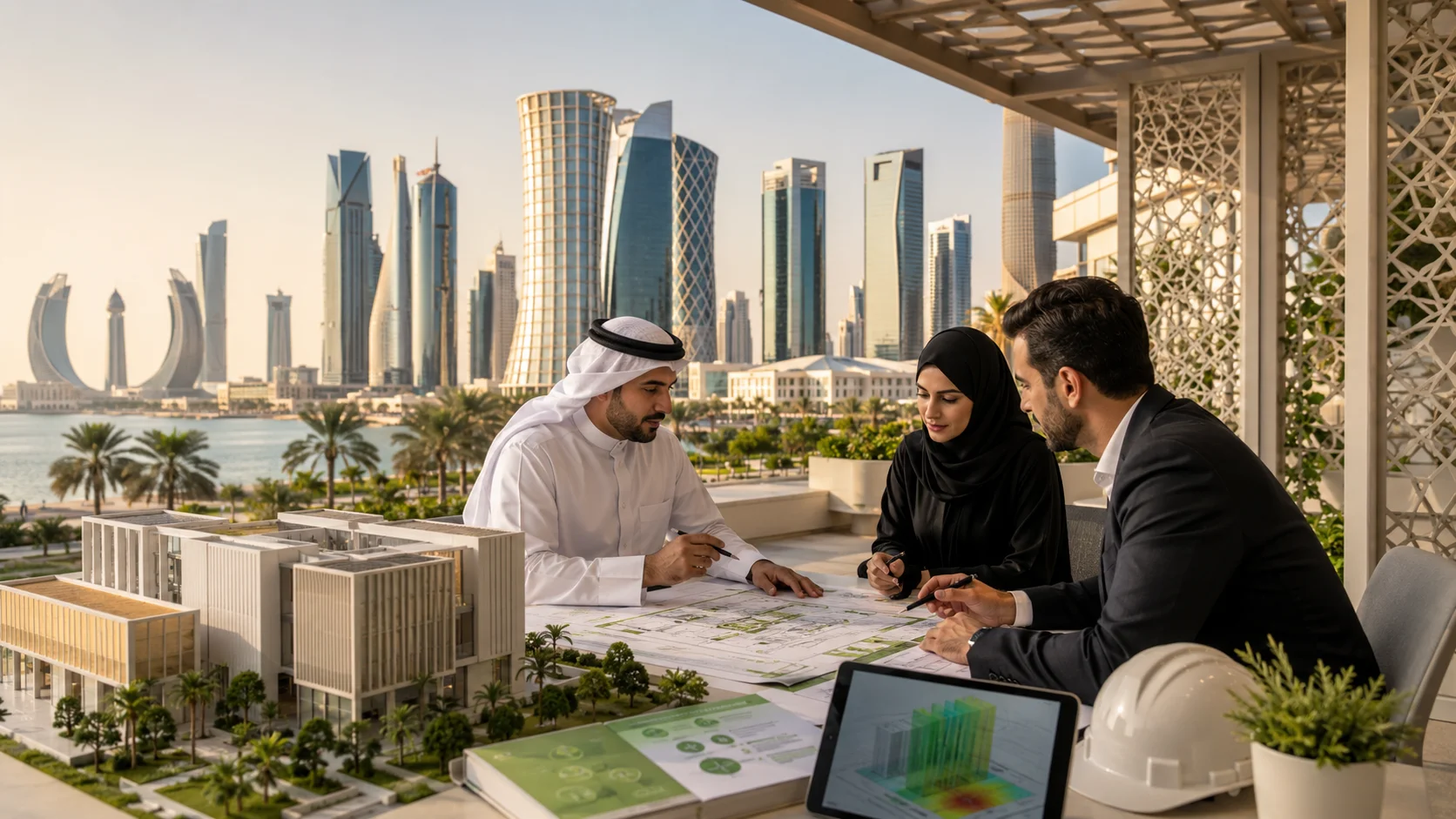
LEED Consultant in Qatar support helps owners turn sustainability goals into clear design, construction, and documentation actions. A skilled LEED Consultant in Qatar also helps project teams reduce certification risk before costly decisions reach site.
Qatar’s real estate market now expects more than attractive architecture. Developers, investors, hotel operators, corporate tenants, and public project teams want buildings that perform well in heat, use water responsibly, support occupant comfort, and prove their sustainability claims. LEED gives these teams an international framework for that goal.
For projects in Doha, Lusail, Msheireb, West Bay, The Pearl, and industrial zones, early LEED planning matters. The right consultant can align architects, MEP engineers, contractors, suppliers, and owners around one practical scorecard. That coordination saves time and protects certification value.
LEED Consultant in Qatar: What Does the Role Include?
A LEED consultant guides a building project from the first sustainability target to the final certification submission. This role includes rating system selection, feasibility review, credit strategy, technical coordination, documentation control, and review response support.
The consultant does not simply collect files near handover. That late approach creates gaps. Instead, the consultant builds the certification route during concept design and keeps each discipline accountable.
Core services usually include scorecard preparation, credit planning, drawing reviews, product evidence checks, commissioning coordination, and review response support. USGBC describes LEED as a global green building rating system for healthy, efficient, and cost-effective buildings. You can review the official LEED rating system for its current scope and certification levels.
Why LEED Certification Matters for Qatar Projects
Qatar’s climate creates a direct need for high-performance design. Cooling loads, solar gain, water scarcity, material logistics, and indoor comfort all affect long-term asset value. LEED helps teams address these issues with measurable strategies.
A certified project can strengthen market positioning. It can also support ESG reporting, tenant attraction, investor confidence, and operational cost control. For premium offices, hotels, education buildings, healthcare assets, and mixed-use developments, certification can become a clear proof point.
Qatar also places sustainability inside its national development agenda. The environmental pillar of Qatar National Vision 2030 highlights renewable energy, water conservation, biodiversity, and sustainable practices. LEED aligns well with these priorities because it connects design decisions to measurable building outcomes.
How ERKE Supports LEED Projects in Qatar
ERKE helps project teams create a realistic path to certification from the first design meetings. Our team combines green building consultancy, energy expertise, material sustainability, and documentation management under one coordinated process.
Through our LEED Consulting service, we help owners define the certification level, choose credits, and reduce technical uncertainty. This approach works especially well for complex projects with many consultants and fast schedules.
LEED Consultant in Qatar for Early Design Decisions
The best time to involve a consultant is before schematic design ends. At that stage, the team can still influence orientation, envelope performance, outdoor comfort, district cooling interfaces, water systems, ventilation, daylight, and material choices.
Early action helps the owner avoid expensive redesign. It also gives the MEP team enough time to model energy performance, test system options, and coordinate commissioning needs.
A strong early workshop should answer five questions: Which rating system fits the project? What certification level makes business sense? Which credits offer the best return for Qatar’s climate? What documents must each consultant produce? Which risks need design changes now?
LEED Consultant Qatar Support During Construction
Construction teams need clear requirements, not vague sustainability language. The consultant should convert the LEED scorecard into procurement rules, site procedures, submittal templates, and inspection routines.
Contractors need guidance on waste management, erosion control, low-emitting materials, refrigerant data, commissioning records, and product declarations. Suppliers also need clear deadlines for technical evidence.
When this system starts early, the project avoids last-minute document gaps. The final submission then becomes a controlled process rather than a stressful rescue mission.
Key LEED Credit Areas for Qatar
Not every credit has the same value in Qatar. A good strategy focuses on credits that improve performance and fit local constraints.
Energy and Cooling Performance
Energy performance usually drives major value. Qatar projects often face high cooling demand, so the team should optimize the building envelope, HVAC systems, controls, metering, commissioning, and renewable energy options.
District cooling, façade shading, glazing selection, heat recovery, and smart controls can all affect the scorecard. The consultant should work closely with the energy modeller and MEP designer.
Water, Materials, and Indoor Quality
Water efficiency carries strong relevance in Qatar. Project teams should assess indoor fixtures, irrigation demand, native planting, condensate recovery, greywater options, and leak detection.
Material choices also influence certification outcomes. Teams should evaluate Environmental Product Declarations, responsible sourcing, recycled content, low-emitting finishes, and construction waste planning.
People spend long hours indoors, so comfort matters. LEED supports better air quality, thermal comfort, daylight, acoustic performance, and low-emitting materials.
Step-by-Step LEED Certification Process
A clear process helps every stakeholder know what comes next. USGBC’s Guide to LEED Certification explains the official certification route and review framework.
For most projects, the workflow starts with goals, rating system selection, and a target scorecard. Then the team runs design workshops, integrates LEED requirements into drawings, tracks documentation, reviews submittals, responds to comments, and promotes certification after approval.
This workflow needs discipline. Yet it becomes easier when the consultant, owner, designer, and contractor work from the same checklist.
Common Mistakes to Avoid
Many projects lose time because the team treats LEED as an add-on. That mindset creates avoidable problems.
Avoid starting coordination after major design choices. Do not set a certification target without a credit feasibility review. Include contractor duties in tender documents. Check material evidence before procurement. Treat commissioning as a performance tool, not a final-stage formality.
Frequently Asked Questions
What does a LEED consultant do in Qatar?
A LEED consultant in Qatar manages the certification strategy, scorecard, technical coordination, and documentation process. The consultant helps the project team meet LEED requirements while adapting decisions to Qatar’s climate, market, and project goals.
When should we hire a LEED Consultant in Qatar?
You should hire a LEED Consultant in Qatar during concept or early schematic design. Early involvement helps the team shape the site, envelope, systems, water strategy, materials, and documentation plan before key decisions become costly.
Is LEED suitable for hotels, offices, and mixed-use projects in Qatar?
Yes. LEED can support hotels, offices, retail spaces, residential towers, education buildings, healthcare assets, and mixed-use projects. The correct rating system depends on the scope, ownership model, fit-out level, and operational goals.
Conclusion
LEED Consultant in Qatar services can help owners turn sustainability ambitions into measurable project results. Strong outcomes come from early planning, clear credit strategy, disciplined documentation, and practical coordination across design and construction teams.
Qatar’s built environment continues to move toward efficient, resilient, and healthier buildings. LEED gives project teams a trusted international framework for that shift. ERKE helps you apply that framework with technical clarity and commercial focus.
Ready to discuss your project? Contact ERKE through our contact page and get expert support for LEED Consultant in Qatar services.